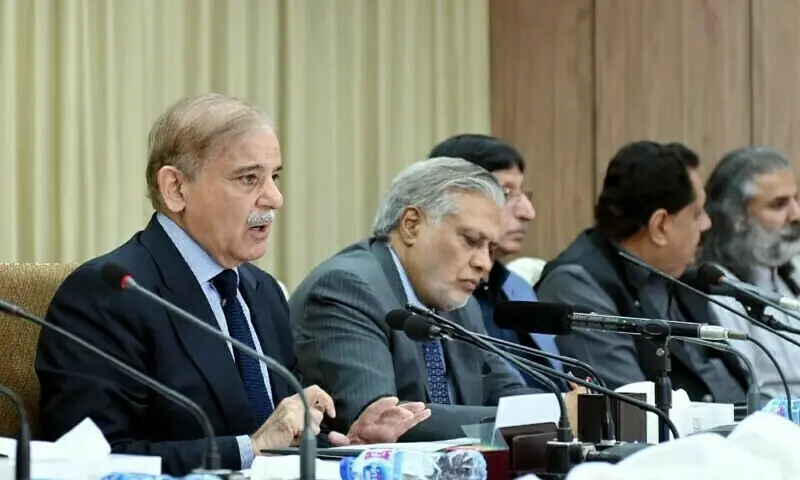
PM Shehbaz briefs Nawaz on political, regional crises amid Pakistan’s diplomatic push
Prime Minister Shehbaz Sharif met Nawaz Sharif at Jati Umra to discuss Pakistan’s diplomatic efforts amid the Middle East conflict and brief him on fuel relief measures.

Premier updates PML-N supremo on domestic situation, Middle East conflict as CM Maryam also attends Jati Umra meeting
Takes PML-N supremo into confidence over ‘situation in the country,’ outlining fuel relief measures amid global energy turmoil
Apprises him of latest situation in the Middle East and Pakistan’s diplomatic efforts aimed at restoring peace in the region
LAHORE: Prime Minister Shehbaz Sharif on Sunday briefed PML-N supremo Nawaz Sharif on the “situation in the country” as the two leaders exchanged views on the domestic political landscape and the ongoing conflict in the Middle East, according to state media.
“Prime Minister Shehbaz Sharif called on PML-N supremo Nawaz Sharif at their Jati Umra residence in Lahore on Sunday, where they discussed the Middle East conflict and the political situation in the country,” said a statement issued by the Prime Minister’s Office (PMO).
وزیرِ اعظم محمد شہباز شریف کی جاتی امراء آمد، قائد مسلم لیگ (ن) میاں محمد نواز شریف سے ملاقات
ملاقات میں ملکی سیاسی صورتحال پر تبادلہ خیال ہوا اور وزیرِ اعظم محمد شہباز شریف نے میاں محمد نواز شریف کو ملکی صورتحال کے حوالے سے بریف کیا۔
ملاقات میں وزیرِ اعلی پنجاب مریم نواز شریف… pic.twitter.com/F3OxcoPqOF— Government of Pakistan (@GovtofPakistan) May 3, 2026
Maryam Nawaz was also present during the meeting.
The PMO said the premier took Nawaz Sharif into confidence over the “situation in the country” and exchanged views on political developments, besides apprising him of the latest situation in the Middle East and Pakistan’s diplomatic efforts aimed at restoring peace in the region.
Prime Minister Shehbaz Sharif arrived at Jati Umra and met with PML-N President Muhammad Nawaz Sharif.
Prime Minister Shehbaz Sharif briefed Nawaz Sharif on the country’s current situation. pic.twitter.com/U5wFzooMCr— PMLN (@pmln_org) May 3, 2026
The conflict in the Middle East, now stretching beyond two months, erupted after US-Israeli strikes on Iran on February 28. Although active hostilities have remained suspended since a Pakistan-brokered two-week ceasefire on April 8 — later extended indefinitely by US President Donald Trump — the fallout from the war continues to reverberate globally.
Pakistan’s civil and military leadership has remained engaged in intensive diplomatic efforts, positioning Islamabad at the forefront of regional de-escalation initiatives.
On April 11 and 12, Pakistan hosted the first high-level contact between Iran and the United States in decades, facilitating the meetings later dubbed the “Islamabad Talks.” However, amid difficulties in arranging a second round, Islamabad has since reverted to its role as a facilitator and intermediary.
The conflict has also led to the closure of the Strait of Hormuz, through which one-fifth of the world’s oil and gas supplies would normally pass in peacetime, triggering a global energy crisis and driving up oil prices in international markets.
According to the PMO, Prime Minister Shehbaz also briefed Nawaz Sharif on the surge in international oil prices and the government’s measures to shield the public from its impact.
After the US-Israeli war on Iran began, the government initially raised petrol and diesel prices by Rs55 per litre on March 6 and announced sweeping austerity measures on March 9.
In the weeks that followed, Prime Minister Shehbaz said he had turned down recommendations to further increase fuel prices on three separate occasions despite continued volatility in the global market.
However, on April 2, Petroleum Minister Ali Pervaiz Malik and Finance Minister Muhammad Aurangzeb announced an unprecedented increase of 43 per cent and 55pc in petrol and high-speed diesel prices, respectively, alongside a targeted fuel subsidy programme.
A day later, Prime Minister Shehbaz reduced the petroleum levy by Rs80 per litre, bringing the price of petrol down to Rs378 per litre.
On April 10, the premier further cut diesel and petrol prices by Rs135 and Rs12 per litre, respectively. Since then, the government has twice revised fuel prices upward — first on April 24 and again on April 30.
Comments
No comments yet. Be the first to join the discussion!