

Pakistan remains in polio’s ‘last mile’ despite sharp fall in cases
Pakistan has again neared polio eradication, with only one reported case so far in 2026, but officials and health workers say the final phase remains the hardest. Missed children, refusals and hidden transmission continue to challenge the campaign.

ISLAMABAD: Pakistan has again moved close to interrupting poliovirus transmission, but the disease has not been eliminated and remains difficult to detect, according to a report that highlighted the country’s repeated setbacks in the final phase of eradication, accordong to a report by Dawn.
Four-year-old Shahmeer from Sujawal in Sindh became Pakistan’s first reported polio case of 2026 on March 5, despite having received routine vaccinations for pneumonia, diarrhoea, measles, typhoid and poliovirus, with every box on his vaccination card marked complete. The child did not show visible symptoms, continued to play normally, did not complain of joint pain and showed no signs of paralysis because he had contracted non-paralytic polio, a form of the disease that can go unnoticed, sometimes appearing only as a mild flu, while still spreading the virus.
Laboratory analysis linked the virus found in his gut to a positive environmental sample from Hyderabad, indicating continued transmission in Sindh.
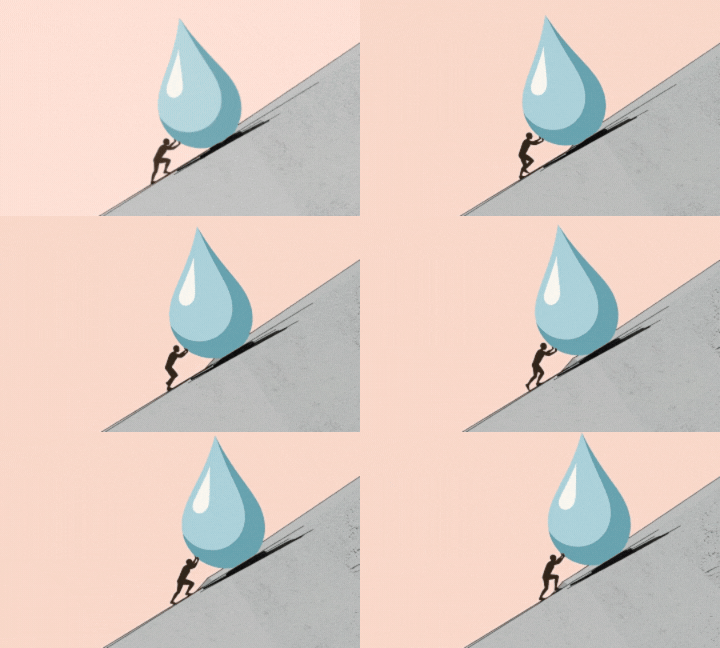
Prime Minister’s focal person Ayesha Raza Farooq said Pakistan is now in what is called the last mile, described as the most difficult stage of eradication. The country reached this point three times in the past decade: in 2017, when eight cases were reported, in 2021, when only one case was recorded, and in 2023, when six cases were reported. Each time, however, progress was followed by another rise in infections. By the end of 2025, the case count had reached 31.
Three months into 2026, only one case had been reported, while most sewage samples had tested negative for the virus. Unicef Sindh team lead Azeem Khawaja said this had created hope that Pakistan could reach zero cases by the end of 2026.
Pakistan must remain free of cases for at least three consecutive years to be declared polio-free, with no virus detected in humans, environmental samples or laboratory testing.
Vaccination gap remains a challenge
Pakistan must vaccinate 95 per cent of children to cross the final threshold. Although each campaign targets more than 45 million children, around 43 million are reached. That shortfall of roughly two million children represents the remaining gap in the last mile.
During the February and April campaigns this year, 950,000 and 300,000 children respectively were not vaccinated. Between 800,000 and one million children are usually missed in each nationwide drive.
These missed children include those in homes where doors are not opened, children who are away when teams arrive, and cases where parents refuse to allow vaccination.
Trust and resistance in the field
door-to-door work by polio teams in Karachi’s Dalmia area, in UC-7 of Gulshan Town, where workers moved through narrow lanes early in the morning after receiving instructions from their supervisor.
One team member, Samina, was quoted as saying that long familiarity with neighbourhood residents helped the campaign.
At the same time, familiarity exists alongside mistrust. One woman had spat on worker Parmeela and accused her of poisoning children, while a man pulled a gun on Samina whenever she came to his door. In some households, fathers refused vaccination, but mothers later brought children out for drops when the men were away and asked workers not to mark the child’s finger, requesting that the dose be recorded only on the official tally sheet.
The workers attributed resistance to rumours that the vaccine causes infertility, is un-Islamic, or is intended to reduce the population of a particular ethnicity.
For a period, police accompanied vaccination teams, but Parmeela said that this created greater fear and suspicion. The current arrangement, is that a police van remains stationed some distance away and officers are rarely directly involved. Teams are instructed to keep trying, report refusals if persuasion fails, and involve supervisors or police if tensions rise.
Pakistan remains one of only two countries in the world where wild poliovirus transmission has never been interrupted, alongside Afghanistan. It cited WHO/UNICEF estimates for 2024 showing 87pc coverage for the full three-dose polio course, 94pc coverage for the first vaccine dose, and a 7pc dropout gap among children who begin but do not complete the course. Epidemiologists estimate transmission stops only when at least 90pc of children complete the full three-dose schedule.
Comments
No comments yet. Be the first to join the discussion!


