

SC says neutrality of electoral officers is vital to democratic order
The Supreme Court has said election officials must act with complete neutrality and transparency, warning that manipulation during vote consolidation threatens democratic legitimacy. The court also ordered the ECP to notify PNAP’s Khushal Khan Kakar as the returned candidate from NA-251.

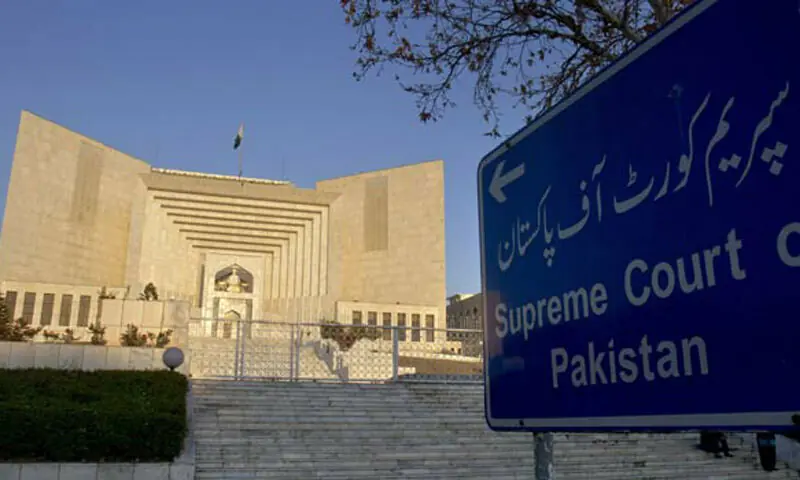
ISLAMABAD: The Supreme Court has underlined that election officials must perform their duties strictly in line with the law, with transparency and complete impartiality, warning that any departure from neutrality during the electoral process threatens not only a single contest but the democratic system itself.
In detailed reasons issued by Justice Shakeel Ahmed, the court said "Any deviation from neutrality or departure from the statutory framework, during the election process, imperils not merely the outcome of a particular election, but the democratic order itself"
The judge added that "only through these principles public confidence in the electoral process is sustained and the sovereign will of the electorate is preserved".
Justice Ahmed was part of a three-member bench that set aside a Nov 24, 2025 ruling of the Balochistan Election Tribunal and directed the Election Commission of Pakistan (ECP) to notify Pakhtunkhwa National Awami Party’s Khushal Khan Kakar as the returned candidate from NA-251 (Sherani-cum-Zhob-cum-Killa Saifullah) in the Feb 8, 2024 general election.
The bench, headed by Justice Shahid Waheed, heard appeals filed by Kakar and his rival, Jamiat Ulema-i-Islam’s Syed Samiullah.
The dispute stemmed from the 2024 general election, in which Samiullah was first declared the returned candidate by the ECP on Feb 18 after securing 46,210 votes, while Kakar had obtained 46,117 votes. Kakar challenged that notification before the Election Tribunal, which partly accepted his petition, declared the returned candidate’s election void and ordered repolling at 22 disputed polling stations.
Forms-45 and 48
In his detailed reasoning, Justice Ahmed said electoral officials are trustees of the public mandate and guardians of the integrity of the election process. He said Form-45 is the primary and contemporaneous record of votes counted at each polling station and is prepared immediately after counting in the presence of candidates or their authorised agents, giving it statutory sanctity.
By contrast, the judgment said, Form-48 is only a consolidated statement compiled from Forms-45. The returning officer, it added, has no adjudicatory power to alter, replace or recalculate the result recorded in Forms-45, except to correct obvious clerical mistakes apparent on the face of the record and only in accordance with the law.
The judgment said the returning officer is bound by strict statutory obligations, including neutral and transparent conduct of the election, and must act as an impartial official charged with preserving the integrity of the process. Justice Ahmed said the returning officer’s role is to compile results from Forms-45 into Form-48 and 'cannot modify or alter the votes unless ordered or an obvious clerical or arithmetical mistake was discovered and corrected transparently in accordance with law.'
The court further said the returning officer must ensure the record accurately reflects the votes cast.
"If the RO deducts votes from a candidate and adds them to another without lawful authority, the act constitutes tampering with election results, abuse of statutory process and violation of election laws", the court stated.
Justice Ahmed said such conduct 'materially affects the election results and undermined the democratic process'.
Court’s observations
Referring to the case before it, the judge said the difference between Forms-45 and Form-48 pointed to a serious irregularity. He observed that by reducing the appellant’s votes and adding them to the respondent, the returning officer appeared to have gone beyond his statutory authority and may have acted with mala fide intent.
The judgment said the alteration completely reversed the election result, materially affected the outcome and damaged the integrity of the electoral process. Justice Ahmed said the matter before the Supreme Court went to the core of constitutional democracy and the sanctity of the ballot.
He said that in a constitutional system based on representative government, the legitimacy of public institutions ultimately depends on the integrity, transparency and credibility of elections. Where doubts arise over whether the electorate’s will, as expressed at polling stations, has been faithfully carried through the statutory consolidation process, the issue goes beyond the fortunes of individual candidates, he observed.
Justice Ahmed also referred to Article 218(3) of the Constitution, saying it places a solemn and non-negotiable obligation on the ECP to organise and conduct elections honestly, justly and fairly, and to guard vigilantly against corrupt practices.
"This constitutional command is not directory, but mandatory. Any manipulation at the stage of vote consolidation erodes democratic legitimacy and shakes the foundations of the people’s mandate", he said.
The judgment added that an administrative officer cannot be permitted to substitute his own arithmetic for the sovereign will of the electorate. Where the true vote count is evident from uncontroverted Forms-45, duly acknowledged by the ECP, their authenticity cannot be doubted, Justice Ahmed said.
He further said the Supreme Court was not powerless in such circumstances and that where evidence conclusively shows that the appellant secured a lawful majority, the proper course is not to order a repoll but to declare the appellant elected.
"The law neither condones manipulation nor permits its fruits to endure. Tampering at the consolidation stage by the RO is even more perilous than irregularities at the polling station", Justice Ahmed emphasised.
Comments
No comments yet. Be the first to join the discussion!


