

Pakistan’s plastic reform push hinges on integrating informal recyclers
Pakistan is considering a national plastic waste framework that would shift cleanup costs to producers, but experts say it must include informal waste pickers. Industry and policy voices say phased implementation and local integration will be crucial.

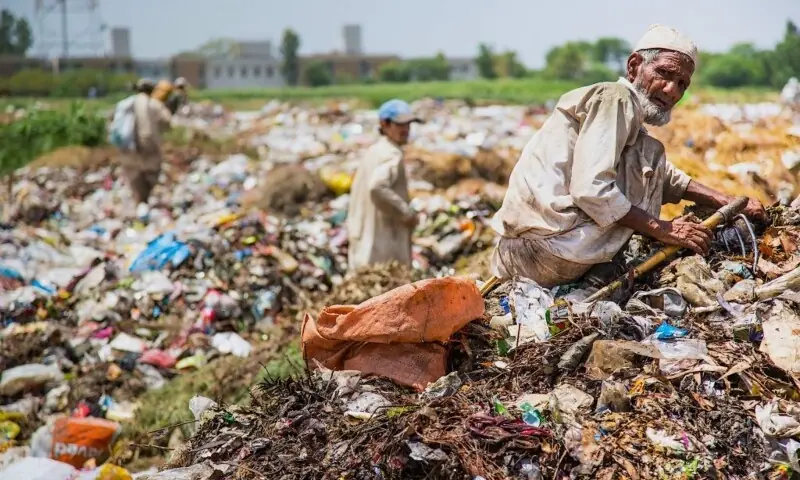
KARACHI: Pakistan is moving towards a national system to make companies responsible for the waste created by their packaging, but experts and industry representatives say the effort will only work if it includes the country’s vast informal recycling workforce.
The issue is visible on the streets of Karachi, where children such as 11-year-old Irfanullah Wahid and his 10-year-old cousin Faisal Asadullah collect discarded material for resale. Wahid gathers metal cans, while Asadullah looks for thicker plastic that can fetch money from recyclers. Thin plastic shopping bags and laminated wrappers are usually left behind because, as Asadullah put it, “The kabadiwallah (recycler) won’t pay for this,” he says.
Pakistan generates about 2 million tonnes of plastic waste each year, but only 15-18 per cent is recycled. Without urgent action, that volume is projected to rise to 12 million tonnes by 2040. The consequences outlined in the report include worsening urban flooding in cities such as Karachi and Lahore due to blocked drains, plastic entering the Arabian Sea, the spread of microplastics into soil, crops, water and human bodies, and air pollution caused by the burning of mixed waste.
Food and beverage companies, NGOs, recyclers and packaging firms have formed the CoRE Alliance and, in 2025, joined government representatives in calling for a national Extended Producer Responsibility (EPR) framework. Under that model, companies would bear the cost of collecting, recycling and safely disposing of packaging waste through producer responsibility organisations that have yet to be established.
Hussain Ali Talib, head of communications at Unilever Pakistan, said, “The goal is simple: better plastic management today, lasting circularity for the future.”
Informal workers central to waste recovery
Dr Ayesha Khan, chief executive officer of the Akhtar Hameed Khan Foundation, said any EPR framework must recognise the estimated 200,000 to more than 333,000 people working in Pakistan’s unorganised waste sector. She said waste pickers and recyclers should be treated as “frontline partners” because they handle about 40pc of Pakistan’s waste.
“Without acknowledging this invisible force, EPR cannot succeed,” she said.
Khan said that in urban areas, a large share of waste is managed by informal pickers, many of them women and children, working in unsafe and unregulated conditions. In Karachi alone, she said, around 40,000 waste pickers recover between 500 and 1,000 tonnes of waste every day from streets and informal dumping sites beyond the reach of municipal crews.
“Waste pickers are the invisible hands keeping our cities from becoming piles of waste,” said Khan.
These workers generally operate without gloves, masks or boots, and without identification, contracts or health coverage.
Pollution burden and policy debate
the Indus as one of the most plastic-polluted rivers in the world. In Karachi, floating accumulations of waste include plastic, bottles and Styrofoam. A 2022 World Bank study cited in the report found that plastic waste in the river was “overwhelmingly greater” in weight and proportion than any other type of waste, with single-use items accounting for one in every four plastic pieces. Nationally, Pakistan discards 55 billion plastic bags every year, and the number is rising.
Khan said the Akhtar Hameed Khan Foundation is testing what she called a “scalable pilot” in Sahiwal’s Bhutto Nagar locality, where individual waste pickers are being organised into cooperatives and linked with the municipal system and recycling markets.
Talib said Unilever’s experience with EPR in other regions can “provide a great learning opportunity for adopting those best practices to businesses in Pakistan, specially towards policy framing while staying aligned to local laws”. He added that companies could contribute expertise if they are included in government decision-making.
Pakistan’s climate minister Dr Musadik Masood Malik told Dialogue Earth: “I feel a rule-regime that supports the small and medium-sized recycling enterprises will not only rejuvenate the circular economy in the plastic centre, but it also makes good economic sense. If the rules are clear and consistent, enforcement will be easier.”
Challenges of formalising an informal system
Pakistan’s informal economy accounts for an estimated 59pc of GDP and employs millions outside formal state oversight. In the waste sector, pickers, itinerant buyers and small recyclers form a decentralised chain that collects, sorts and resells plastic and other materials. But many lack formal identification, social protection and stable incomes, while their livelihoods often depend on staying outside regulatory systems that could expose them to taxation or eviction.
Zia Naqi, chief executive officer at SPEL and a member of the 29-member CoRE Alliance, said bringing local informal actors into the system would be difficult. “Bringing them to the table will be the biggest challenge,” he said.
He added, “The cost of cleaning up waste will fall on the formal sector,” and warned of “squeezing ethical companies with higher costs and a tougher ease-of-doing business environment closely watched by investors.”
Khan said the formal sector may initially carry more of the burden, but argued that cost-sharing could improve as trust develops. “It’s a messy area. What needs to happen is alignment of incentives with climate-smart policies. Informal waste pickers are on the fringes and invisible. That is why we all must advocate and organise them,” Khan said.
Waqar Ahmad, chief executive officer of the CoRE Alliance, told Dialogue Earth that the group is working towards a Pakistan-specific EPR framework based on international practices before legislation is introduced. He said implementation would need to be practical, phased and coherent, adding, “No company can recycle all its waste from the outset — it simply won’t work.” He suggested beginning at “10pc and gradually scaling up to 80-100pc”.
Comments
No comments yet. Be the first to join the discussion!

