

Pakistan reiterates call to end or curb UNSC veto, opposes new permanent seats
Pakistan has reiterated at the UN that the Security Council veto should be abolished or tightly restricted and opposed any expansion of permanent membership. Ambassador Asim Iftikhar Ahmad also proposed steps to raise the political cost of using the veto.

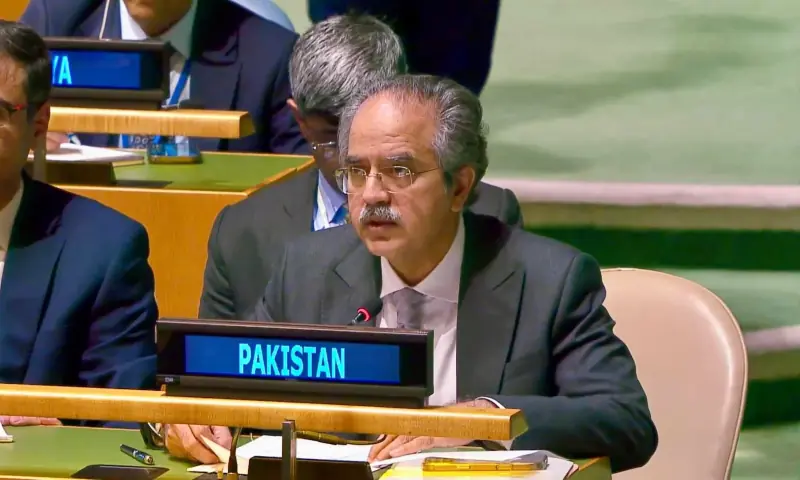
ISLAMABAD: Pakistan has reiterated its longstanding position calling for either the abolition or strict restriction of veto power in the United Nations Security Council (UNSC), while opposing any expansion of permanent membership in the body.
The stance was presented by Pakistan’s Permanent Representative to the United Nations, Asim Iftikhar Ahmad, during a resumed session of the Intergovernmental Negotiations (IGN) process on UNSC reform.
He said Pakistan’s policy on the issue remained clear and consistent, arguing that the introduction of additional veto-wielding members would further complicate already stalled decision-making within the Council.
Ahmad said Pakistan firmly opposed both the expansion of veto powers and the addition of new permanent members, describing the position as one of principle and aligning it with the Uniting for Consensus group.
The UNSC currently consists of five permanent members — China, France, Russia, the United Kingdom and the United States — alongside 10 non-permanent members elected by the UN General Assembly. The veto power held by permanent members has repeatedly resulted in the blocking of resolutions, including on major conflicts such as the war in Gaza.
The envoy said repeated use or misuse of the veto has contributed to paralysis within the Council, preventing timely action on international peace and security issues. He added that this concern is widely shared across member states as well as in academic and policy circles outside the United Nations.
He described the veto as increasingly anachronistic in the context of modern global governance, questioning proposals that would expand rather than reform the privilege.
At the same time, Ahmad acknowledged that the veto remains a structural reality of the UN system, with permanent members unlikely to concede their authority. He said Pakistan therefore supported steps aimed at improving transparency and accountability in its use.
He stressed that UNSC reform must be comprehensive and addressed as a single package, arguing that selective or partial changes would fail to resolve core structural imbalances.
To reduce the dominance of permanent members, Pakistan proposed increasing the number of elected non-permanent seats. Ahmad argued that a larger elected membership would raise the political cost of veto use by making it more difficult to override broader consensus.
He suggested that under an expanded Council, a higher threshold of affirmative votes would be required for resolutions, thereby strengthening the influence of elected members.
The envoy also proposed regional consultation mechanisms for decisions affecting specific regions, saying such an approach could enhance accountability and strengthen regional ownership in decision-making processes.
He concluded that meaningful reform must prioritise fairness, representation and balance, reiterating Pakistan’s position that privilege should not be concentrated among a few states.
Comments
No comments yet. Be the first to join the discussion!


