

Experts warn against taxing solar energy
Experts at a policy dialogue warned that taxing solar panels and batteries would hurt consumers and weaken Pakistan’s energy security. They urged a faster shift towards renewables, storage and grid modernisation.

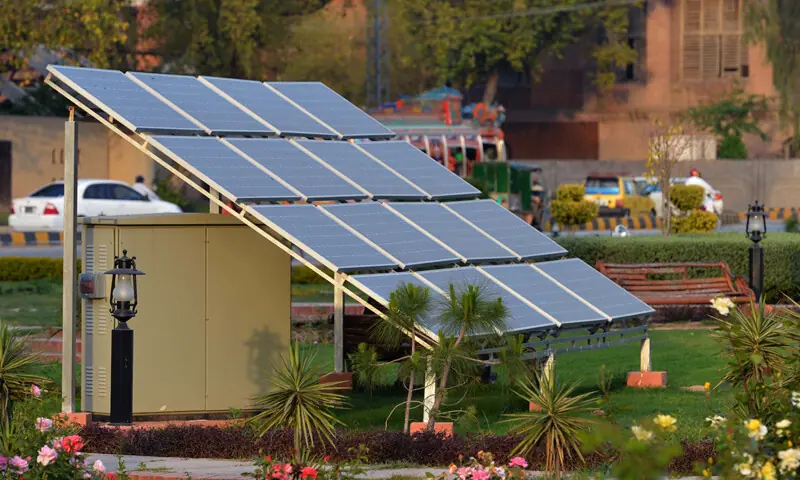
ISLAMABAD: Participants at a consultative dialogue on Pakistan’s energy future cautioned the government against imposing taxes on solar panels and batteries, saying such measures would weaken national energy security and penalise consumers who have helped stabilise the economy amid global shocks.
The event, titled “Beyond the Barrel: Making Pakistan Energy Secure in an Era of Geopolitical Shocks,” was organised by the Pakistan Renewable Energy Coalition (PREC) in collaboration with the Alliance for Climate Justice and Clean Energy (ACJCE) and the Sustainable Development Policy Institute (SDPI).
Economic and energy expert Dr Abid Qaiyum Suleri emphasised that Pakistan must accelerate its shift to renewable energy and storage solutions to shield the economy from international fuel volatility. He warned that successive global energy shocks were driving up inflation and eroding gains made under the current IMF programme, noting that if oil prices surpass $105 per barrel, domestic inflation could surge into double digits, placing immense pressure on household budgets and social safety nets.
“Taxing solar panels and batteries at this juncture would undermine both energy security and consumer protection,” Dr Suleri said.
Lidy Nacpil, Coordinator of the Asian Peoples’ Movement on Debt and Development (APMDD), highlighted the twin challenges many Asian economies face: high sovereign debt and legacy power purchase agreements that lock in capacity payments. She stressed that citizens have a role in pressing their governments for credible renewable energy policies and urged Pakistan to renegotiate existing agreements to ease the financial burden on both consumers and the national exchequer.
Speakers at the dialogue agreed that energy security can no longer rely solely on imported fuels and that public resources must urgently be redirected towards renewables, storage, and grid modernisation.
Framing the geopolitical context, Engr Ubaidur Rehman Zia, head of the Energy Unit at SDPI, said the global energy system had assumed stable shipping lanes and supply chains, an assumption now disrupted by the Strait of Hormuz crisis. Rising international fuel prices are not only increasing generation costs but also feeding directly into the cost of essential services, transport, and food, disproportionately affecting low-income households.
Nabiya Imran of Renewables First presented the case for solar energy as a strategic shield. She noted that since 2018, Pakistan’s citizens-led solar expansion has helped avoid an estimated $12 billion in oil and gas imports, strengthening national energy security and protecting the balance of payments. She urged policymakers to provide consistent policy signals to institutionalise investment in storage and flexible renewable resources.
From a legal and industrial perspective, Muhammad Abdul Rafe of the Alternative Law Collective observed that rising gas prices have driven many industrial users towards self-generated solar power, reducing demand for imported LNG. However, he warned that contractual rigidities and misaligned planning could lead to a surplus of 24 LNG cargoes between July 2025 and December 2031.
Muhammad Badar Alam, CEO of the Policy Research Institute for Equitable Development (PRIED), affirmed civil society’s support for an evidence-based, just, and resilient energy transition. He noted that recommendations from the dialogue would inform advocacy around the FY2026–27 federal budget, aligning fiscal measures with long-term energy security, affordability, and climate goals.
The dialogue concluded with a consensus that Pakistan must move beyond reactive fuel cost adjustments and adopt a proactive, renewable-led energy framework that shields the economy from external shocks, safeguards consumers, and positions the country for a cleaner and more sovereign energy future. Participants warned that the ongoing global volatility, exacerbated by the Strait of Hormuz crisis, underscores Pakistan’s vulnerability to international fossil fuel markets.
1 Comment
No comments yet. Be the first to join the discussion!

