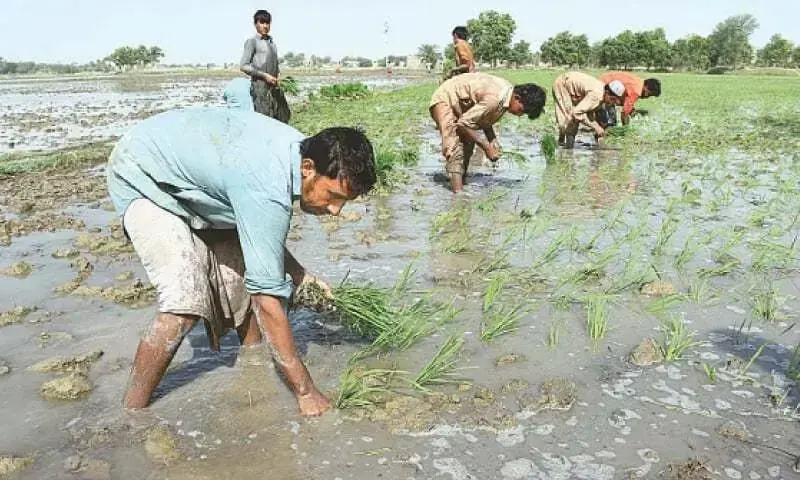
Sindh farmers call Rs1,500 per acre subsidy inadequate
The Sindh Abadgar Board has termed the provincial government’s Rs1,500 per acre subsidy inadequate, saying it covers only a small fraction of growers. The board also raised concerns over wheat prices, rising input costs and limited reach of the Hari Card scheme.

HYDERABAD: The Sindh Abadgar Board (SAB), a key farmers’ lobbying group, has criticised the provincial government for what it describes as inadequate support for small farmers, warning that the agriculture sector is slipping deeper into crisis.
At a meeting held in Hyderabad and chaired by Mahmood Nawaz Shah, the board expressed concern over the subsidy being offered to farmers, calling the Rs1,500 per acre support “paltry” and insufficient to address rising costs.
In a statement issued after the meeting, the SAB acknowledged that the Hari Card initiative was a positive step but pointed out that it covers less than 20% of small farmers across the province. The group argued that policymakers appear disconnected from on-ground realities, stressing that agriculture was already under severe strain even before the recent surge in diesel prices.
Farmers highlighted that crop prices have remained consistently low over the past two years, a period also marked by declining production and the impact of natural disasters. Wheat, in particular, was cited as a major casualty of what farmers described as price manipulation.
Following the devastating 2022 floods in Sindh and Balochistan, wheat was priced at Rs4,000 per 40 kilograms. However, by early 2024, the rate had dropped sharply to Rs2,200 per 40 kg after the government halted procurement to meet International Monetary Fund conditions. Although procurement has since resumed, the current official price stands at Rs3,500 per 40 kg—still below earlier levels. Farmers claim that open market traders are offering even less, around Rs3,200.
The SAB blamed government policies for the worsening situation, arguing that authorities often import agricultural commodities during harvest periods and restrict exports, while allowing input costs to rise unchecked. The group also pointed to a lack of institutional support in areas such as seeds, technology, research, and development, adding that reduced investment and limited mechanisation further reflect policy shortcomings.
According to the board, the Rs1,500 per acre subsidy—limited to a fraction of registered farmers—will do little to offset the economic pressure, especially with fuel price hikes expected to increase cultivation costs by up to Rs12,000 per acre, partly due to the regional impact of the Iran conflict.
Sindh has around 2.6 million farming households, with more than 90% classified as small farmers. However, only about 330,000 have received the Benazir Hari Card so far, leaving the majority without direct support.
The SAB has called for urgent and practical measures to stabilise the sector, including reducing taxes and levies, preventing price manipulation, and ensuring better support for agricultural inputs. The group warned that without immediate intervention, the province’s agro economy risks further decline.
Several farmers and stakeholders, including Dr Bashir Nizamani, Syed Nadeem Shah, Imran Bozdar, Taha Memon, and Masroor Soomro, attended the meeting.
Comments
No comments yet. Be the first to join the discussion!