

Chinese fossil discovery points to earlier burst of animal evolution
A fossil assemblage from China’s Yunnan province suggests animal life diversified in the Ediacaran Period earlier than previously known. Researchers say the discovery sheds new light on the transition before the Cambrian Explosion.

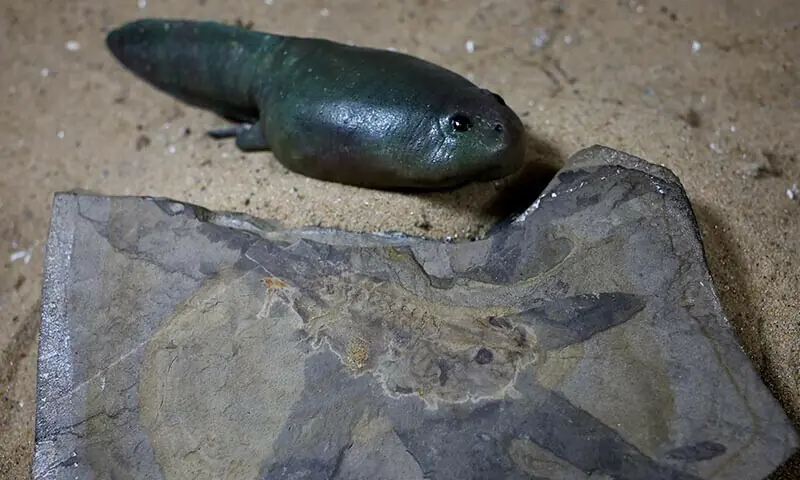
WASHINGTON: A newly described fossil assemblage from China suggests that animal life in Earth’s early seas diversified millions of years earlier than previously understood, according to research published on Thursday in the journal Science.
Paleontologists uncovered about 700 fossils of small, soft-bodied animals that lived roughly 546 to 539 million years ago during the Ediacaran Period. The fossils, found in Yunnan province and collectively called the Jiangchuan Biota, capture what researchers described as a major phase of change in early animal life.
The specimens were preserved as carbonaceous films, a dark, two-dimensional carbon layer left after organisms were compressed during fossilisation. Researchers said this mode of preservation retained anatomical features including guts as well as structures linked to feeding and movement.
The find is considered important because it indicates that a rapid diversification of animal life was already underway in the Ediacaran, before the better-known Cambrian Explosion of the following period. By the end of that Cambrian evolutionary expansion, early representatives of most major animal groups alive today had emerged.
“We found a fossil site which gives us new information about the rise of complex animal life, before the Cambrian Explosion. We found evidence of animal groups that are otherwise found only about 520 million years ago - after the peak of the Cambrian Explosion - existing in the late Ediacaran Period, more than 20 million years earlier,” said paleontologist Frankie Dunn of the University of Oxford, one of the authors of the study.
Life in a changing world
During the Ediacaran, Earth differed sharply from the modern planet. It was emerging from a severe global icehouse phase known as Snowball Earth, the continents were arranged very differently, and oxygen levels in the atmosphere were far lower. It was in this setting that the first animal life appeared in the seas.
The earliest undisputed animal fossils are dated to about 574 million years ago and include organisms resembling fern fronds or feathers. Previously known Ediacaran animals also included sponges and cnidarians, the group that includes jellyfish and corals.
“If you were to peer back into the Cambrian, you would be able to recognise much of the animal life around you, but this is not the case during the Ediacaran, where recognisable animals would likely be few and far between. Our new site shows a world in transition, moving into the complex animal-dominated world we see around us today,” Dunn said.
Ancient deuterostomes and unusual forms
Among the Jiangchuan Biota fossils, researchers identified what they said are the oldest known members of the broad group called deuterostomes. This is significant because vertebrates, including humans, belong to that group, although the Ediacaran forms were anatomically very different from later vertebrates.
The fossils also included bilaterian animals, whose bodies can be divided into equal halves. Researchers said that while most animals today are bilaterian, their presence in the Ediacaran marked an important evolutionary development.
Some fossils belonged to animals with a U-shaped body that lived attached to the seafloor by a stalk and had a pair of tentacles on the head used to capture food. These were described as early members of the animal group that includes modern starfish and acorn worms.
Researchers also identified a creature they named the bugle worm because of its loose resemblance to the musical instrument. It had a worm-like body fixed to the seafloor and a proboscis that could turn inside out.
“When we were collecting fossils in the field, we were all surprised by how diverse the fauna was and how abundant the fossils were,” Dunn said.
“We expected to see more and more evidence of animals in the Ediacaran, but animals like the bugle worm tell us that not all of these will be forms that we could predict from the living diversity of animal life or even from the Cambrian Explosion,” Dunn said.
“This tells us that there is still a lot to learn about the radiation of animal life and the nature of the transition from the Ediacaran to the Cambrian.”
Comments
No comments yet. Be the first to join the discussion!


