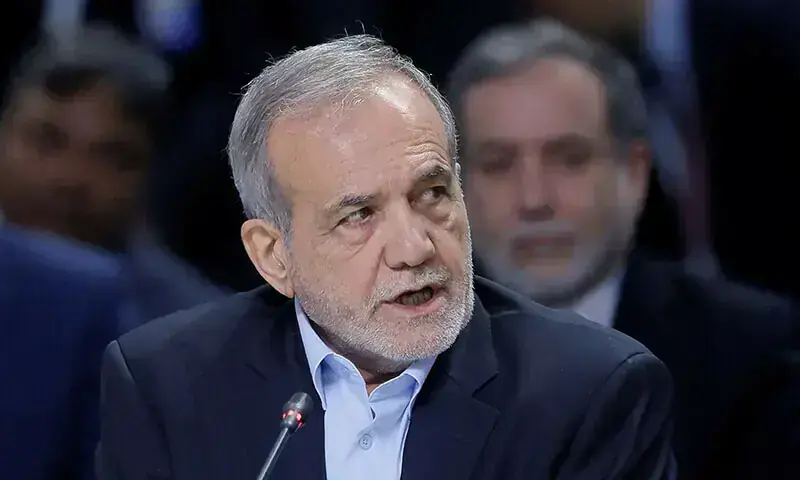
Iranian president urges countries not to allow 'enemies to run the war' from their territories
Iranian President Masoud Pezeshkian urges regional nations to prevent enemies from using their territories to wage war, emphasizing the need for security and development.

TEHRAN: Iranian President Masoud Pezeshkian on Saturday urged regional countries not to allow "enemies to run the war" from their territories if they "want development and security".
"We have said many times that Iran doesn't carry out preemptive attacks, but we will retaliate strongly if our infrastructure or economic centres are targeted," Pezeshkian wrote on X.
Addressing the countries of the region, the Iranian president added: "If you want development and security, don't let our enemies run the war from your lands."
Tensions in the Middle East have escalated since February 28, when the US and Israel launched a joint attack on Iran that has killed more than 1,900 people so far, including then-Supreme Leader Ayatollah Ali Khamenei.
Iran has retaliated with drone and missile strikes targeting Israel and Gulf countries that are home to US military assets.
Iran vows to exact heavy price
Iran’s Foreign Minister Abbas Araghchi has warned that Tehran would exact a “heavy price” for what he described as Israeli attacks on key industrial and nuclear infrastructure, as hostilities between the two sides intensified.
In a social media post, Araghchi said Israel had struck two of Iran’s largest steel factories, a power plant and civilian nuclear facilities, adding that Israel claimed the operation was carried out in coordination with the United States.
Iran’s Revolutionary Guards echoed the warning, urging workers at industrial sites with American ties or links to Israel to “leave their workplaces immediately,” signalling the possibility of further retaliatory strikes.
US-Israeli strikes earlier in the day hit two Iranian nuclear facilities — the Khondab heavy water complex and a uranium processing plant in Ardakan — along with two major steel plants. Israeli forces confirmed the attacks, while Iranian authorities said there had been no radioactive release.
Israel’s military said Iran responded by firing missiles, with one person killed in Tel Aviv and at least four others wounded. Air raid sirens sounded in Jerusalem, while explosions were reported near Jericho in the occupied West Bank.
More strikes while Trump speaks of negotiations
Washington has dispatched two contingents of thousands of Marines to the region, the first of which is due to arrive in the coming days aboard a large amphibious assault ship. The Pentagon is also expected to deploy thousands of elite airborne soldiers.
The deployments have raised concerns that the war will turn into a prolonged ground battle.
Stock markets tumbled sharply on Friday while the Brent crude oil benchmark LCOc1 topped $112, having risen more than 50% since the war began.
In the US, where Trump is politically vulnerable to rising fuel prices, diesel in California hit a record average high of $7.17 a gallon, the American Automobile Association said.
Trump has appeared eager to wind down the unpopular war, emphasising this week what he called productive negotiations aimed at a diplomatic solution - despite repeated assertions from Tehran that no such talks have begun. On Thursday, Trump extended a deadline by 10 days for Iran to reopen the Strait of Hormuz or face attacks against its civilian energy grid.
At least five people were killed and seven injured after a US-Israeli attack on a residential unit in Iran's northwestern city of Zanjan, Iranian media reported early on Saturday. The Iran University of Science and Technology in Tehran was also struck.
Iranian Foreign Minister Abbas Araqchi said on X that Israel, in coordination with the US, had also hit two steel factories and a power plant. "Attack contradicts POTUS extended deadline for diplomacy. Iran will exact HEAVY price for Israeli crimes," Araqchi said on Friday, using an acronym for the president of the United States.
Israel's military said on Saturday it had detected incoming missiles from Iran, and Syrian state television reported explosions heard above the capital Damascus from Israeli intercepts of the Iranian missiles.
The United Arab Emirates and Bahrain also reported missile attacks early on Saturday.
Comments
No comments yet. Be the first to join the discussion!