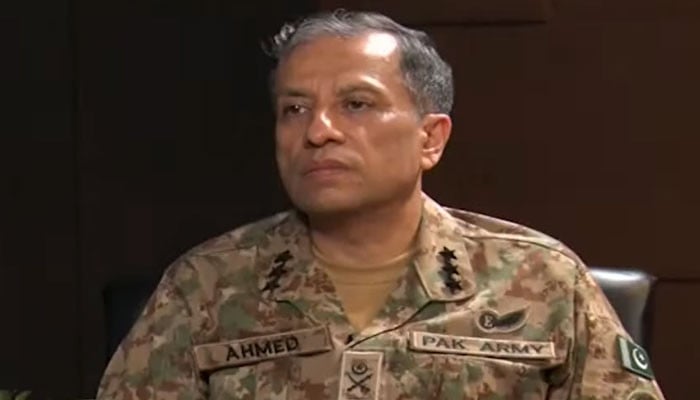
‘Pakistan Targeted Ammo Depot’: DG ISPR dismisses Afghan claim of hitting drug rehab centre
DG ISPR Lieutenant General Ahmed Sharif Chaudhry rejects Taliban claims of an airstrike on a drug rehab centre, asserting the target was a military ammunition depot.

DG ISPR rejects Taliban claims, Pakistan targeted military and terrorist infrastructure, not any rehab centre
Points out explosions of stored ammunition caused visible flames across Kabul
Disputes civilian casualties, stressing use of precision-guided munitions ensured focused targeting of terrorist facilities
Questions Taliban credibility, calling Afghan regime’s claims ‘discredited and dishonest’
Reaffirms Pakistan acts to contain terrorist threats for national and global safety
Says all suicide bombers who carried out attacks in Pakistan were drug addicts
ISLAMABAD: Inter-Services Public Relations (ISPR) Director-General Lieutenant General Ahmed Sharif Chaudhry on Wednesday rejected what he described as “ridiculous” claims that Pakistan had targeted a drug rehabilitation centre in Afghanistan, clarifying that the military had struck an ammunition storage depot.
The remarks came after the Taliban regime’s deputy spokesperson, Hamdullah Fitrat, claimed on Tuesday via X that an airstrike had hit the Omid Addiction Treatment Hospital in Kabul, reportedly killing up to 400 people. Pakistan forcefully dismissed the allegations, calling them “entirely baseless” and part of a wider pattern of misinformation aimed at distorting facts.
Information Minister Attaullah Tarar had earlier emphasised that the strikes were “precise, deliberate, and professional,” targeting only military and terrorist infrastructure linked to attacks inside Pakistan. Meanwhile, a United Nations Assistance Mission in Afghanistan (UNAMA) report cited to Reuters put the death toll in the alleged incident at 143.
Addressing the matter during an interview on the private television programme Capital Talk, Lt-Gen Chaudhry said: “They’re saying there was some drug rehabilitation centre there. Someone ask them—why build a drug rehab centre in the middle of an ammunition storage? Which hospital in the world is located beside missiles and ammunition? It was never there.”
He noted that the site was a military camp and a drone storage facility in Kabul, which had been targeted by Pakistan. “We hit the pinpoint location. The clip is still available, and the whole world saw secondary detonations because our intelligence was accurate and we struck an ammunition storage, which exploded,” he said.
“When the ammunition detonated, flames rose across Kabul for some time because of the explosives,” he added, describing the site as containing Soviet-era Scud missiles and other ordnance.
Rejecting claims of civilian casualties, the DG ISPR emphasised that Pakistan used precision-guided munitions rather than general-purpose bombs. “We were very careful. PGMs were used directly on terrorist support infrastructure, which is exactly what was done there,” he said.
He questioned the credibility of the Afghan Taliban’s claims: “Who is making these allegations? It is the Taliban regime, which, just 10 days ago, claimed a Pakistani pilot was targeted while in civilian clothes. The same account posts these claims and then deletes them. The world knows they are discredited and dishonest.”
Lt Gen Chaudhry further stated that the Afghan Taliban regime had previously rounded up drug addicts and kept them at the so-called rehab centre, using them for terrorism and suicide attacks. “All suicide bombers who carried out attacks in Pakistan were drug addicts. While all drug addicts are not suicide bombers, all suicide bombers are terrorists,” he said.
He explained that while the structure in question was not a primary target, secondary detonations caused the fire and damage. “It was a military-contained facility, which may have housed suicide bombers in training, terrorists, Afghan Taliban members, or allied militias. I don’t know exactly what was stored there,” he said.
Addressing concerns about civilian casualties, the DG ISPR noted the blurred distinctions under Taliban rule: “When our posts are attacked, some attackers wear uniforms, some Afghan Taliban military uniforms, and others fight alongside them in civilian clothes. Who counts as a civilian?”
He added that Afghanistan was not a conventional state but a territory under Taliban control, a terrorist organisation and a master proxy under which other groups operate. Quoting a UN report, he said 22 terrorist organisations currently operate in Afghanistan.
“Afghanistan has become the centre for terrorists across the world—a can of worms which Pakistan has pushed to close,” he said. “Pakistan is not fighting this war only for its own borders but for the security of the entire region and the world.”
Recent drone incidents
When asked about the recent drone attacks in Islamabad, Rawalpindi and other areas, he questioned whether there was a drone manufacturing industry in Afghanistan. He said this supported Pakistan’s narrative that someone was providing these drones to be used against Pakistan, identifying India.
“They are providing rudimentary drones so that their signatures can be claimed as not theirs,” he said, adding that it highlighted the deep nexus between India’s intelligency agency and the Afghan Taliban.
He said Pakistan had a very effective air defence system, in which the Pakistan Air Force and Army Air Defence operated collectively, with the Air Force taking the lead role. “They monitor and take down drones through a combination of hard and soft kill,” he said.
Endgame and Indian role
When asked about the endgame of the war, the DG ISPR said Pakistan had a single objective: to ensure that Afghanistan was not used as a base for terrorism inside Pakistan.
“The choice has to be made by the Afghan Taliban regime: what is more important to them, TTP or Pakistan; is terrorism important or peace? They have to make a choice,” he added, saying the regime must decide whether to protect itself or destroy the Tehreek-e-Taliban Pakistan.
“Every child in Pakistan knows that India is behind this terrorism, using Afghanistan as its base of operations. It is Indian-sponsored, funded terrorism whose base of operations is Afghanistan,” the DG ISPR said.
He said that in every terrorism-related incident in Pakistan, Afghanistan was used as the base of operations.
War imposed on Pakistan
Providing details of incidents in which terrorists carried out attacks on Pakistan from Afghanistan, he said that on the blessed day of Friday, an attack was carried out in Tarlai in which worshippers were martyred, adding that the attacker had come from Afghanistan where he had received training and preparation.
He added that attacks were carried out in Wana and Bannu, targeting mosques, police and civilians, and said all attackers were coming from Afghanistan.
Questioning where the leaders of these terrorists were, he said they were being sheltered in Afghanistan.
He rejected the notion that Pakistan had imposed any war on Afghanistan, saying the war on terror had been imposed on Pakistan and that thousands of its citizens had been killed with the country fighting the war for decades. He said no other country in the world had fought a war against terrorism the way Pakistan, its people and its security forces had.
The DG ISPR clarified that Pakistan had no issues with the people of Afghanistan, describing them as "brothers and sisters", and said they themselves were victims of the same group.
“They themselves are victims of their oppression, they themselves are under these warlords, who have imposed this war, who have no connection with Islam, they are on their mercy, they themselves are living under them,” he said.
He said that Pakistani forces targeted “terrorist hideouts” along the Pakistan-Afghan border last month. “We did not target Afghans; we targeted terrorists,” DG Chaudhry stressed.
The military spokesperson said that forces of the Afghan government subsequently struck Pakistani posts at 53 locations. “They started it by attacking Pakistan along the border at regular posts, and this is our response,” he added, referring to Operation Ghazab Lil Haq, which has now been temporarily paused.
The DG ISPR said Ghazab Lil Haq was not a standalone operation but part of Pakistan’s ongoing war against terrorism, adding that the country was fighting a war imposed by terrorists and their sponsors.
He said that when the Afghan Taliban struck at 53 locations, Pakistan began striking them inside their country, adding that everyone must understand the neighbouring regime had initiated the conflict. "We responded and now we are going to take them to task," the military spokesperson added.
The DG ISPR said that Pakistan had so far carried out airstrikes at 81 locations, adding that all these strikes were targeted against terrorist support infrastructure.
He said that through Operation Ghazab Lil Haq, those waging terrorism against Pakistan were also beginning to feel its cost. “You can no longer carry out terrorism in Pakistan with impunity. You attack our posts, martyr our children, target our women, innocent people, our mosques — you will also pay the price. That must be understood, and that has already started,” he said.
The DG ISPR added that Pakistan was a responsible and prudent state and was not targeting the people of Afghanistan. “We have no problem with them; we know they are helpless at the hands of this cruel group. That is why we are targeting terrorist hideouts, imposing a cost on them,” he said.
Talks with Afghanistan
On a question about negotiations with Afghanistan, he said Pakistan had never refused dialogue. “We have held talks with them multiple times — with friends, directly, and multilaterally. We have a very just demand, which our friendly countries acknowledge: you cannot say you will talk and at the same time send terrorists into our country. These two things cannot go together,” he said.
He added that the Afghan Taliban regime produced two things: terrorism and drugs. “This is their business, and both are interlinked. Terrorism and the war economy are a way of life for them; that is how they thrive,” he said, adding that it used dialogue, diplomacy and religion as a cover.
“They have no connection with the religion of Islam. They call themselves an ‘emirate’. Where in Islam is it written to commit terrorism? Where is it written to carry out suicide bombings? Suicide is haram in Islam. Does this have anything to do with Islam? Where is it written in Islam to oppress people or generations? Islam is against all this,” he said.
He added that if people lived peacefully and lawfully, Pakistan had no problem with them. “But if you provide space to these terrorists and treat them as your own, then we have a problem. Their leadership and patrons will ultimately be brought to justice. Allah has destined for them hell in this world and the hereafter,” he said.
Comments
No comments yet. Be the first to join the discussion!