

Pakistan rejects US claim of missile threat, reaffirms 'India-focused' deterrence policy
Pakistan has firmly rejected US claims regarding its missile capabilities, emphasizing its defensive strategy focused on India. The Foreign Office calls for a factual dialogue with the US.
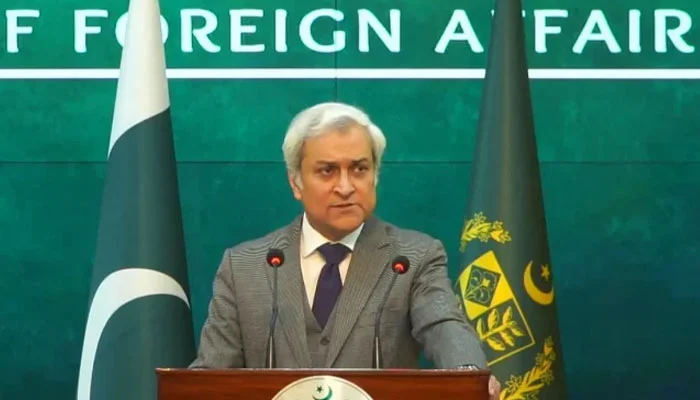
ISLAMABAD: Pakistan on Thursday firmly dismissed allegations by Tulsi Gabbard that its missile capabilities pose a threat to the United States, terming the assertion “unfounded” and detached from strategic realities.
In a statement, Foreign Office spokesperson Tahir Hussain Andrabi said Pakistan’s strategic capabilities are “exclusively defensive,” aimed at safeguarding sovereignty and ensuring peace and stability in South Asia.
He underscored that Pakistan’s missile programme remains well below intercontinental range and is anchored in a doctrine of credible minimum deterrence vis-à-vis India.
Contrasting regional dynamics, Andrabi pointed to India’s development of missiles exceeding 12,000 kilometres in range, calling it a trajectory that raises broader security concerns beyond the region.
Pakistan, he added, remains committed to constructive engagement with the United States based on mutual respect and factual accuracy, urging a more measured approach aligned with regional stability.
Earlier, former caretaker foreign minister Jalil Abbas Jilani also rejected Gabbard’s remarks, stating that claims of Pakistan’s missiles reaching the US homeland are “not grounded in strategic reality.” He reiterated that Pakistan’s nuclear doctrine is India-specific and not intended for global power projection.
Speaking before the United States Senate Intelligence Committee, Gabbard had warned that several countries, including Pakistan, are developing advanced missile systems that could potentially threaten the US homeland, projecting a sharp rise in global missile threats over the next decade.
Analysts view Pakistan’s inclusion in such assessments as a continuation of longstanding US policy trends. In December 2024, Washington imposed additional sanctions targeting entities linked to Pakistan’s ballistic missile programme over concerns about potential long-range capabilities.
Pakistan Slams Israeli Envoy’s ‘Rogue State’ Remark, Cites Gaza Atrocities
Foreign Office also strongly rejected remarks by Reuven Azar, calling them a “baseless characterisation” and accusing Israel of deflecting from its own record of aggression.
In a statement, the FO said the “real record of rogue conduct” lay in Israel’s actions, pointing to the ongoing humanitarian crisis in Gaza, illegal occupation, and legal challenges faced by Israeli leadership in international courts.
“Responsible states uphold international law — not deflect from it,” the statement added.
The response came after a video of Azar’s interview with Indian anchor Arnab Goswami circulated online, in which he alluded to a “rogue state” possessing nuclear weapons while discussing regional tensions and Pakistan’s ties with Gulf countries.
Azar’s remarks were made in the context of a Pakistan-Saudi Arabia defence pact signed in September 2025 and the ongoing conflict involving the US, Israel, and Iran, which has increasingly drawn in regional players.
Islamabad’s rebuttal signals rising diplomatic tensions as the broader Middle East crisis continues to spill over into regional discourse.
Comments
No comments yet. Be the first to join the discussion!


