Pakistan silences unprovoked cross-border firing by Afghan Taliban ‘immediately and effectively’
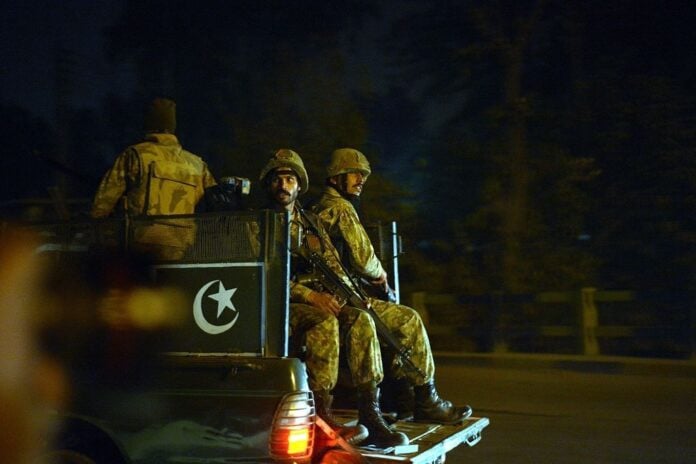
Pakistan's security forces effectively responded to unprovoked cross-border firing by the Afghan Taliban, reaffirming their commitment to protect citizens and territorial integrity amidst rising tensions.

PM's spokesperson says security forces responded immediately to silence unprovoked aggression
Reaffirms Pakistan would ‘continue to protect its citizens and guard its territorial integrity’
ISLAMABAD: Security forces responded immediately to stop unprovoked firing by the Afghan Taliban at the Pakistan-Afghanistan border on Tuesday amid intense friction between the two countries, according to the prime minister's spokesperson.
"The Afghan Taliban regime initiated unprovoked firing along the Pakistan-Afghanistan Border in Torkham and Tirah sub-sectors. Pakistan’s security forces responded immediately and effectively, silencing the Taliban aggression," said Mosharraf Zaidi, Prime Minister Shehbaz Sharif's spokesperson for foreign media, in a post on X.
In a post on the social media platform X, he said, “Pakistan’s security forces responded immediately and effectively, silencing the Taliban aggression.”
The Afghan Taliban regime initiated unprovoked firing along the Pakistan-Afghanistan Border in Torkham & Tirah sub-sectors.
Pakistan’s security forces responded immediately & effectively, silencing the Taliban aggression.
Any further provocation will be responded to…— Mosharraf Zaidi 🇵🇰 (@mosharrafzaidi) February 24, 2026
He said that any further provocation would be responded to “immediately and severely”. He said Pakistan would “continue to protect its citizens and guard its territorial integrity”.
The development comes after Pakistan targeted terrorist camps and hideouts overnight in the Nangarhar and Paktika provinces of Afghanistan over the weekend, with an official saying that “more than 80” terrorists had been killed in the air strikes.
The strikes were the most extensive military engagement between the two neighbours since border clashes broke out in October last year.
According to an information ministry statement, issued in the early hours of Sunday, the strikes were carried out in response to a number of terrorist attacks inside Pakistan — such as the suicide bombing at an imambargah in Islamabad and a number of attacks in Bannu and Bajaur.
“Pakistan has conclusive evidence that these acts of terrorism were perpetrated by Khwarij at the behest of their Afghanistan-based leadership and handlers,” it said.
The information ministry said that in a retributive response, Pakistan carried out “intelligence-based selective targeting of seven terrorist camps and hideouts belonging to Pakistani Taliban [Fitna al Khwarij] and its affiliates, and [Islamic State-Khorasan] at the border region of Pakistan-Afghan border with precision and accuracy”.
Fitna al Khwarij is the term the state uses to refer to the banned Tehreek-i-Taliban Pakistan (TTP).
“Despite repeated efforts by Pakistan to urge the Afghan Taliban Regime to take verifiable measures to deny use of Afghan territory by terrorist groups and foreign proxies to carry out terrorist activities in Pakistan, the Afghan Taliban Regime failed to undertake any substantive action against them,” the statement noted.
Earlier this month, a suicide bomber struck the Imambargah Khadijah al-Kubra during Friday prayers in Islamabad, killing 36 people and injuring around 169 others. The attack was the deadliest in Islamabad in more than a decade and the deadliest nationwide since the Peshawar mosque bombing in January 2023.
Immediately following the blast, raids were conducted in Nowshera and Peshawar, resulting in the arrest of four facilitators. The Daesh-linked mastermind, an Afghan national, was also captured. Interior Minister Mohsin Naqvi stated that the network behind the blast was trained in Afghanistan and that authorities had gathered intelligence on the suspects prior to the attack.
In 2023, a UN report also revealed that the banned Tehreek-e-Taliban Pakistan (TTP) had established a new base in K-P in mid-2023. The report shed light on close ties not only between the TTP and the Afghan Taliban but also with anti-Pakistani groups and al Qaeda.
The report further revealed that some Taliban members had also joined the TTP, perceiving it as a religious obligation to provide support.
Interlocutors reported that TTP members and their families received regular aid packages from the Taliban.
Importantly, the UN report noted a significant increase in Afghan nationals in the TTP ranks. This supported Pakistan’s stance that a growing number of Afghan nationals were involved in suicide attacks in the country.
More recently, a UNSC report said that attacks on Pakistan by the TTP from Afghanistan have increased, endorsing Islamabad's long-running complaints about militant sanctuaries across the border. The 37th report by the Analytical Support and Sanctions Monitoring Team, dated February 4, not only endorsed Islamabad's stance that Afghanistan had become a sanctuary for militants who used its territory to launch attacks on Pakistan, but also came at a time when the country is facing a renewed spate of violence.
SHARP RESURGENCE IN TERRORIST ACTIVITY SINCE AFGHAN TALIBAN RETURNED TO POWER
Pakistan has witnessed a sharp resurgence in terrorist activity since the Afghan Taliban returned to power in Kabul in 2021, with Islamabad repeatedly urging the Taliban administration to dismantle sanctuaries for terrorist groups on Afghan soil, particularly those linked to the Tehreek-i-Taliban Pakistan (TTP). Officials say these repeated appeals have largely gone unheeded.
Tensions escalated once again following the Feb 16 vehicle-borne suicide attack on a joint security forces post in Bajaur district, near the Afghan border. In the assault, terrorists affiliated with the TTP attempted to breach the Malangi checkpost, ramming an explosives-laden vehicle into the perimeter wall after an exchange of fire. The attack left 11 Pakistani soldiers martyred, along with a young girl, while seven others—including women and children—were injured when a nearby residential building was damaged in the blast.
Investigations revealed that the suicide bomber, identified as Amad, alias Qari Abdullah or Abu Zar, was a member of the Afghan Taliban’s special forces from Balkh province. The TTP subsequently claimed responsibility for the attack.
Barely days later, on Feb 21, a lieutenant colonel and a sepoy were martyred in another suicide attack during an intelligence-based operation in Bannu district, Khyber Pakhtunkhwa, highlighting the continued threat posed by militants operating across the border.
In an official statement, the Inter-Services Public Relations (ISPR) reaffirmed that terrorists were “using Afghan soil” to carry out attacks inside Pakistan, deliberately targeting the country even during the sanctity of the holy month of Ramazan. The military emphasized that Pakistan would not exercise restraint and operations would continue against perpetrators of such “heinous and cowardly acts,” promising justified retribution against Fitna-al-Khawarij regardless of their location.
The escalating violence prompted Defence Minister Khawaja Asif to warn on Feb 19 that Pakistan would not hesitate to conduct strikes inside Afghanistan should cross-border attacks continue, underlining that military options remain viable.
The cross-border tensions are not new. In November 2025, Zabiullah Mujahid, spokesman for the Taliban government in Afghanistan, alleged that Pakistan had “bombed” Khost province and carried out air strikes in Kunar and Paktika provinces. Pakistan had at the time neither confirmed nor denied the reports, which coincided with a deadly suicide attack on the Federal Constabulary headquarters, leaving three personnel martyred and 12 injured.
These reported strikes followed a series of deadly border clashes at the Pak-Afghan frontier, which resulted in the martyrdom of 23 Pakistani soldiers and the deaths of over 200 Taliban and affiliated terrorists, according to ISPR. The clashes began on the night of Oct 11–12, 2025, after the Afghan Taliban and India-sponsored Fitna-al-Khawarij launched an unprovoked attack on Pakistan along the border, further escalating the cycle of violence.
Officials assert that the recent spate of attacks, including the Bajaur and Bannu incidents, demonstrates that terrorists continue to exploit sanctuaries on Afghan soil to plan and execute operations inside Pakistan. The ISPR reiterated that Pakistan’s military and law enforcement agencies remain fully committed to neutralizing these threats, emphasizing a proactive and decisive approach to defending national sovereignty.
The Feb 16 and Feb 21 attacks, occurring within a week of each other, highlight a pattern of cross-border terrorism, including suicide bombings targeting security forces and civilian populations. Authorities have also noted that such attacks are increasingly coordinated with specialized units of the Afghan Taliban, underscoring the strategic threat posed by well-trained and organized militant factions operating with safe havens across the border.
Senior officials in Islamabad stress that Pakistan’s counter-terrorism operations will continue unabated, both to protect civilians and frontline security personnel and to dismantle terrorist infrastructure along the border regions. The military has also reiterated its willingness to act across the border if necessary, emphasizing that national security imperatives take precedence over diplomatic considerations when terrorist elements exploit foreign soil to target Pakistan.
The spate of attacks has prompted renewed calls for regional coordination to address cross-border terrorism. Islamabad continues to urge the Afghan Taliban administration to take concrete action against the TTP and other militant outfits, dismantling their bases and preventing them from plotting attacks on Pakistani territory. Officials insist that failure to act will leave Pakistan no choice but to safeguard its borders through pre-emptive measures, including military strikes if required.
The Bajaur and Bannu attacks come amid a backdrop of intensifying efforts by Pakistan to strengthen border security and counter-terrorism capabilities in collaboration with local law enforcement and paramilitary forces. These incidents have also reignited public debate on the need for a coordinated regional approach to eliminate sanctuaries used by terrorist groups for launching attacks on Pakistan.
The military has consistently emphasized that such operations are not retaliatory against civilians in Afghanistan, but targeted actions aimed at neutralizing the threat posed by terrorist elements that exploit Afghan territory as a launchpad for attacks on Pakistani soil. ISPR sources reaffirm that Pakistan’s approach remains measured, precise, and legally justified, reflecting a commitment to protecting the lives of its citizens and frontline personnel while adhering to international norms of engagement.
In the wake of these incidents, Pakistani authorities have also stressed the humanitarian cost of terrorism, noting that attacks such as the Bajaur blast not only target security personnel but also endanger civilian lives, including women and children. This underscores the urgent need for Afghan authorities to dismantle terror sanctuaries and for the international community to assist in addressing cross-border militancy.
The recent wave of terrorist attacks, coupled with past clashes and strikes, illustrates the complex and evolving nature of threats along the Pak-Afghan border. Pakistan’s leadership, including military and civilian authorities, has reiterated that every effort will be made to safeguard the country, maintain peace in sensitive border regions, and hold terrorist organizations accountable, wherever they operate.
As Islamabad maintains pressure on Kabul to take action against militant groups, security agencies continue high-alert counter-terrorism operations, patrols, and intelligence-based missions to prevent future attacks, safeguard communities near the border, and ensure the safety of both civilians and law enforcement personnel.
Comments
No comments yet. Be the first to join the discussion!