MQM-P lashes out at Sindh Assembly over ‘unconstitutional’ ‘no-new-province’ resolution
MQM-P criticizes the Sindh Assembly's resolution against new provinces, calling it unconstitutional and emphasizing the need for dialogue over threats.

Khalid Maqbool questions SA’s authority to pass resolutions against ‘Constitution,’ warning against ‘artificial majority’ rule
Party says resolution challenges Pakistan’s Constitution, state, and rule of law, citing Articles 239, 246 and 248, calls for dialogue instead of threats
Memon urges restraint, seeks federal clarification on MQM leaders’ remarks
KARACHI: Muttahida Qaumi Movement-Pakistan (MQM-P) on Sunday launched a sharp critique of the Pakistan Peoples Party (PPP)-led Sindh Government over the “passage of a resolution” opposing the “creation” of any new province, terming it “unconstitutional” and warning that a party with what it described as an “artificial majority” had taken control of Sindh, raising serious constitutional and political concerns.
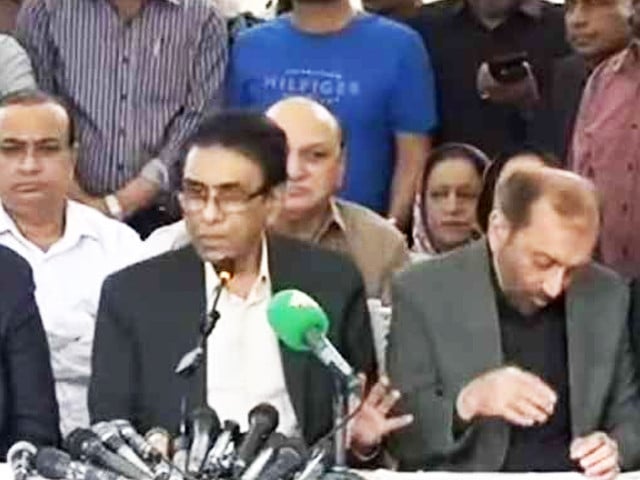
Addressing a press conference in Karachi alongside Mustafa Kamal, Farooq Sattar, and Senator Faisal Subzwari, MQM-P Convener Khalid Maqbool Siddiqui questioned whether the Sindh Assembly could “lawfully adopt” a resolution that conflicted with the Constitution of Pakistan.
The MQM-P leader also took aim at the political history of the PPP, alleging that its trajectory had been shaped by “divisive slogans.” A day earlier, the Sindh Assembly passed a resolution declaring Karachi an “inseparable part” of Sindh and opposing any proposal suggesting otherwise.
“Yesterday, a resolution against the Constitution of Pakistan was passed by one assembly of Pakistan,” Siddiqui said at the outset of his remarks. Referring to Sindh, he added that “a province had carried itself as if it were a separate country.”
Siddiqui, who also serves as the Federal Minister for Education, asked the people and “intellectuals” of Sindh whether any province had the authority to pass a resolution that ran counter to the Constitution. “This resolution challenged Pakistan, its Constitution, its law and its state,” he said, noting that it had been passed by a party that had governed the province for the past 17 years.
He maintained that Article 239 of the 1973 Constitution clearly laid down the procedure for the creation of new provinces. “This resolution is not against any demand of ours but against Pakistan’s Constitution, its state, its existence and even the PPP’s own leader (Bhutto),” he said.
Siddiqui also referred to Articles 246 and 248 of the Constitution, which he said empowered the president to act in extraordinary circumstances. He recalled that MQM-P had consistently demanded the empowerment of local governments, even during the 26th Constitutional Amendment, when “the Pakistani state, government and democracy were in dire need of us.”
Stressing that “dialogue, not threats” was the solution, Siddiqui questioned what fear had prompted the tabling of the resolution, asserting that no demand ever raised by MQM-P violated the Constitution.
Referring to the country’s political history, he recalled that after the trauma of 1970, a show of national solidarity had followed. “Punjab declared Urdu its provincial language. Sarhad (Khyber Pakhtunkhwa) and Balochistan also chose Urdu,” he said, adding that Sindh alone did not take that step because the ruling party had “other dreams and intentions.”
“As long as we are here, every dream of establishing Sindhudesh will be shattered,” he declared. “We will not allow this to happen.”
Discussing electoral history, Siddiqui said that in the 1970 elections, the PPP did not have a single representative from West Pakistan, which constituted 55 per cent of the country, and effectively remained a linguistic party with representation in only 1.5 provinces.
“Today, a party with a manufactured majority has controlled Sindh since 1972,” he said, asking whether such linguistic segregation existed in any other province. He argued that the quota system introduced in 1970 was structured along linguistic lines rather than being a purely administrative arrangement.
Siddiqui questioned the prime minister, the president, the courts, and the state of Pakistan, asking whether cities in Sindh had been treated in a similar manner anywhere else in the country. He said that voices raised for rights in Sindh were routinely branded as traitorous.
He reiterated that MQM-P had never made demands against Pakistan’s interests, adding that when the party’s founding leader made remarks against the country, he was separated from the MQM. “For us, it is Pakistan first, then MQM,” he said.
Memon Urges Restraint After MQM-P Press Conference
Reacting strongly to the MQM-P press conference, Sindh Senior Minister Sharjeel Inam Memon urged MQM leaders to avoid “what he described” as “irresponsible statements” and demanded clarification from the federal government.
He criticised remarks by Khalid Maqbool Siddiqui and Mustafa Kamal, saying they reflected a “lack of constitutional understanding” and were particularly “unfortunate” given that both leaders hold federal ministerial positions.
Memon questioned whether the views expressed at the press conference represented official federal government policy and said the Sindh government expected the Centre to clarify why two federal ministers and an allied party were allegedly engaged in sustained propaganda against the provincial government.
He also said the Governor House, being a constitutional office, should not be used as a centre for political confrontation against the Sindh government. Urging immediate clarification from the federal government, he warned that Pakistan was already facing political and economic challenges and that creating tensions between the federation and provinces would be unwise.
Sindh Assembly Rejects ‘Conspiracy’ to Divide Province
A day earlier, the Sindh Assembly passed a resolution declaring Karachi an “inseparable part” of Sindh and rejecting any move aimed at dividing the province.
The resolution, tabled by Chief Minister Murad Ali Shah and adopted by a majority, stated that the House “unequivocally condemns and rejects any conspiracy aimed at the division of Sindh or the creation of a separate province comprising Karachi.”
“Karachi is, and shall forever remain, an integral and inseparable part of Sindh,” the resolution declared.
The move followed repeated calls by MQM-P for the Centre’s intervention in Karachi, including demands for the metropolis to be declared a federal territory.
The resolution urged all political stakeholders to refrain from divisive rhetoric or actions that threatened provincial harmony and national cohesion, reaffirming that Sindh’s unity, territorial integrity, and historic identity were sacred trusts to be defended through constitutional, democratic, and political means.
Comments
No comments yet. Be the first to join the discussion!