

Supreme Court Justice Mazahar Ali Naqvi's dismissal approved by President Zardari

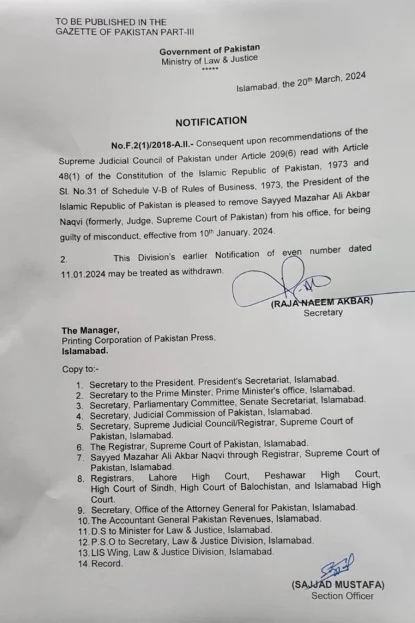
President Asif Ali Zardari has given his approval for the dismissal of Supreme Court (SC) Justice (retd) Mazahar Ali Naqvi, who was recently found guilty of misconduct by the Supreme Judicial Council (SJC). The Ministry of Law and Justice has officially issued a notification regarding the removal of the judge.
The notification stated, “Consequent upon the recommendation of the Supreme Judicial Council of Pakistan under Article 209(6) read with Article 48(1) of the Constitution of the Islamic Republic of Pakistan, 1973 and SI No 31 of Schedule V-B of Rules of Business, 1973, the President of the Islamic Republic of Pakistan is pleased to remove Sayyed Mazahar Ali Akbar Naqvi (formerly, judge, Supreme Court of Pakistan) from his office, for being guilty of misconduct, effective from January 10, 2024.”
Furthermore, the ministry has also withdrawn a previous notification regarding Justice (retd) Naqvi's resignation issued by the division.
In a surprising turn of events in January, Justice (retd) Naqvi had resigned from his post following misconduct allegations, and soon after, fellow judge Justice (retd) Ijazul Ahsan also resigned, prompting inquiries into their abrupt departure.
In his resignation letter, Justice (retd) Naqvi cited public knowledge and records as reasons making it untenable for him to continue serving as a Supreme Court Judge.
However, after conducting misconduct proceedings for over two months, the SJC concluded that the controversial judge was guilty of misconduct, indicating that he should have been removed from his position prior to his resignation.
In a brief statement, the SJC, chaired by Chief Justice of Pakistan (CJP) Qazi Faez Isa, declared that the former judge, facing multiple allegations, was indeed guilty of misconduct and "should have been removed from the office of Judge."
The SJC revealed that it had considered six complaints in chronological order, and while five were found unsubstantiated, it concurred on the guilt of the ex-judge based on nine complaints under Article 209(6) of the Constitution.
This development follows the apex court's recent ruling that proceedings initiated by the SJC against a judge would continue even after their resignation or retirement.

Our monitoring team diligently searches the vast expanse of the web to carefully handpick and distill top-tier business and economic news stories and articles, presenting them to you in a concise and informative manner.
View all articles →Comments
No comments yet. Be the first to join the discussion!


