What is Pickaxe Mountain, the Iranian site linked to Tehran’s nuclear programme?
US President Donald Trump has threatened to strike Pickaxe Mountain, an underground Iranian site near Natanz linked to Tehran’s nuclear programme. Analysts say the deeply buried facility is still under construction and may be difficult to hit from the air.

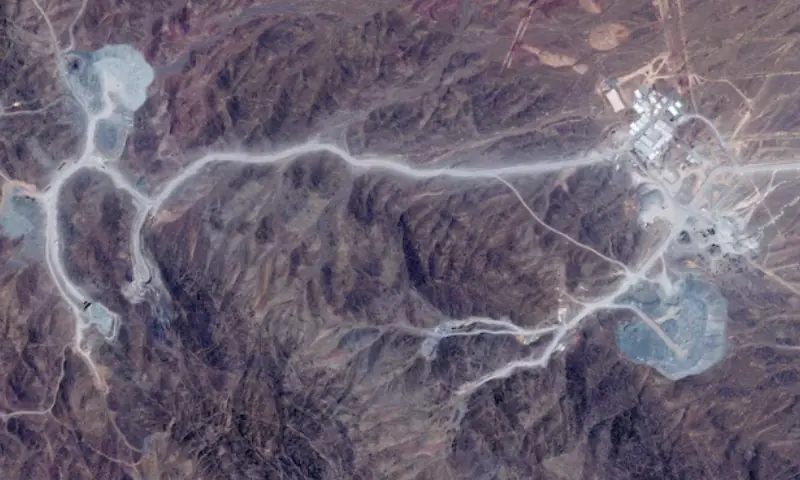
WASHINGTON: United States President Donald Trump has threatened to strike Pickaxe Mountain, a fortified underground site near Iran’s Natanz nuclear complex that is linked to Tehran’s nuclear programme, as tensions between Washington and Tehran continue to rise.
Pickaxe Mountain lies about 220 kilometres south of Tehran and roughly 2km from Natanz. Natanz housed two uranium enrichment plants, one above ground and one below ground. The above-ground facility was destroyed, according to the UN nuclear watchdog, while the underground plant was likely at least badly damaged.
The tunnel complex being built under Pickaxe Mountain was not hit either in the war begun by the United States and Israel on February 28 or during last year’s 12-day war, the Institute for Science and International Security, a US-based think tank focused on nuclear non-proliferation, said. The mountain itself rises to around 1,600 metres above sea level.
Site’s development and Iranian statements
The facility is tied to Iran’s wider nuclear programme, which has long been a source of dispute between Iran and Western countries. Iran has denied seeking an atomic bomb. The Institute for Science and International Security said construction at Pickaxe Mountain began in 2020 after what Iranian authorities described at the time as an act of sabotage that caused an explosion at Natanz.
Iran said then that the Natanz incident caused major damage and could slow work on advanced uranium enrichment centrifuges. In September that year, Iran’s then nuclear chief Ali Akbar Salehi said the country had begun building "a more modern, larger and more comprehensive hall in all dimensions in the heart of the mountain near Natanz"
Rafael Grossi, head of the UN nuclear watchdog, said in a March interview with PBS Frontline that Iran had previously announced its intention to conduct nuclear activity at Pickaxe Mountain. He described this as part of a systematic Iranian effort to move its most sensitive facilities underground. However, an Iranian Foreign Ministry spokesperson said on July 22 that there was no nuclear activity at Pickaxe Mountain.
What satellite imagery shows
The Institute for Science and International Security, citing its analysis of satellite imagery, said the site has two pairs of tunnel entrances that are believed to lead to a single facility at a depth of at least 100 metres beneath the mountain. The defensive layout mainly includes a broad security perimeter and significant reinforcement around the tunnel portals.
The think tank’s July 14 report said the eastern pair of tunnel entrances had been partially backfilled after the wars to hinder access by ground vehicles, though they had not been fully sealed. Sam Lair, a fellow at the Foreign Policy Research Institute who also reviewed recent satellite imagery, told Reuters that strengthening the tunnel entrances would make any attempt to strike the site with penetrating munitions, including bunker-buster bombs, more difficult.
Operational status and military options
Trump said this month that the United States was closely monitoring the site and had not observed activity there. The Institute for Science and International Security said its assessment was that the facility was not yet operational, although construction was continuing, and that satellite imagery alone did not make clear when it might become functional.
The think tank said that if Iran sought to restore its centrifuge manufacturing capability, it could aim to place a smaller centrifuge assembly facility inside Pickaxe Mountain that could support a nuclear weapons programme. Experts assessed that the deeply buried complex is beyond the reach of even the most powerful bunker-buster bombs available in the US arsenal.
The Institute for Science and International Security said the site might be more vulnerable to ground assault or sabotage, although it added that some weaknesses could also potentially be exploited through aerial attacks using deep earth-penetrating weapons.
Comments
No comments yet. Be the first to join the discussion!