

Hitler’s birthplace in Austria reopens as police station
Austria has opened a police station in Adolf Hitler’s birthplace in Braunau-am-Inn after years of legal and political dispute. Officials say the move is meant to discourage neo-Nazi pilgrimages, though critics say the controversy will persist.

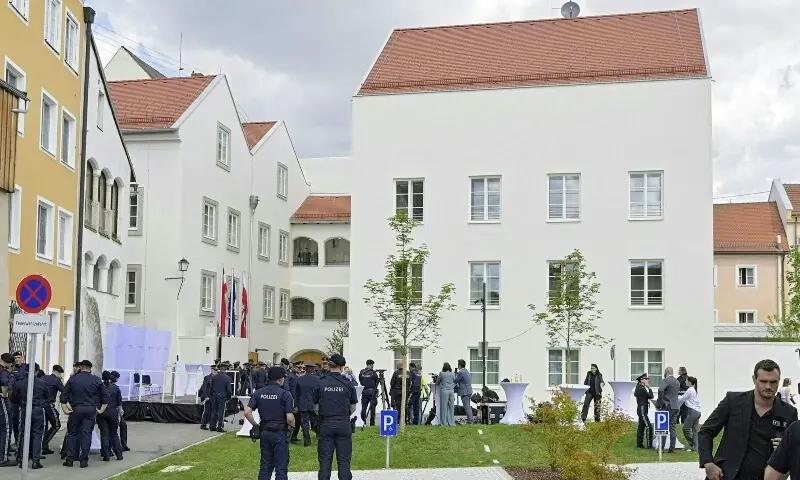
VIENNA: Austria on Wednesday opened a police station inside the house where Adolf Hitler was born, in a move officials say is meant to discourage far-right sympathisers from treating the site as a destination.
The inauguration took place in Braunau-am-Inn, the small Austrian town near the German border where Hitler was born on April 20, 1889. Speaking at the ceremony, Mayor Johannes Waidbacher said he hoped the conversion would demonstrate that the town was confronting its past and accepting responsibility. Interior Minister Gerhard Karner also attended the event.
Waidbacher said the opening of the police station would help settle a long-running local debate over the future of the property and bring some calm to Braunau residents. Few local people attended the ceremony, but 90-year-old resident Erna Seidl said she was relieved that action had finally been taken and that she was pleased with the outcome.
The project followed years of dispute over what should become of the building, in a country that has often faced criticism for failing to fully acknowledge its role in the Holocaust. After a refurbishment costing 20 million euros, or $23 million, and completed three years later than planned, the 17th-century structure has been extensively altered. Its former yellow exterior has been whitewashed by Austrian architectural firm Marte, and a police sign now hangs above the entrance.
A memorial stone remains outside the house, carrying the inscription: For Peace, Freedom and Democracy. Never Again Fascism. Millions of Dead Warn.
Karner said the building would now serve as a symbol of democratic values and legal order while preserving the memory attached to the site. He said the memorial stone, carved from granite from the former Mauthausen concentration camp, would remain in place.
“And at the same time … the memory does not disappear, nothing is covered up. The memorial stone in front of this house, hewn from the granite of the former Mauthausen concentration camp, remains in place,” he said.
Years of legal and political dispute
The property had remained with the same family since 1912. From 1972, it was leased to the Austrian state and used as a centre for disabled people, another group persecuted under the Third Reich. Neo-Nazis had frequently travelled to the address, but the last private owner, Gerlinde Pommer, opposed any redevelopment and challenged the state’s effort to take control of the site.
Austria passed a law in 2016 to expropriate the neglected property. Three years later, the Supreme Court approved the state purchase of the 800 square-metre building for 810,000 euros.
Historians had rejected demolition of the house and instead urged Austria to openly address its part in Nazi crimes, including the murder of more than six million Jews as well as Roma, LGBTQ people and communists. An expert commission ultimately recommended converting the building into a police station. The Austrian government said the plan would make clear that no glorification of Nazism would be tolerated and would neutralise the location.
Debate over symbolism continues
Not everyone agreed the move would solve the issue. Robert Eiter, spokesman for the Mauthausen Committee Austria, told AFP the idea that the redevelopment would erase the site’s significance was misguided.
“But that’s absurd: humanity will not forget where the worst mass murderer in history was born,” Robert Eiter, spokesman for the Mauthausen Committee Austria, an association of escapees from the concentration camp, told AFP .
“And this renovation will not prevent a single neo-Nazi from making the pilgrimage to Braunau.”
Former interior minister Wolfgang Peschorn, who was in office when the decision was taken, said placing a police station responsible for upholding the rule of law in the house sent the clearest possible democratic message. Andreas Pilsl, the head of police in Upper Austria, said officers assigned there understood the significance of the location and its history.
Florian Kotanko of Braunau’s Association for Contemporary History said he did not believe the controversy had ended, saying Braunau would continue to be known internationally as Hitler’s birthplace.
After Nazi Germany annexed Austria in 1938, 65,000 Austrian Jews were killed and another 130,000 were driven into exile. Today, Austria’s most popular political party is the far-right FPOe, founded by former Nazis, and polling aggregator Europe Elects says it is backed by around 37 per cent of Austrians.
Comments
No comments yet. Be the first to join the discussion!


