

From poplars to pistachios, Afghans rediscover the value of trees
Afghanistan is expanding community and government-backed tree planting after decades of deforestation. Experts say forest cover has improved since 2011, but major challenges remain.

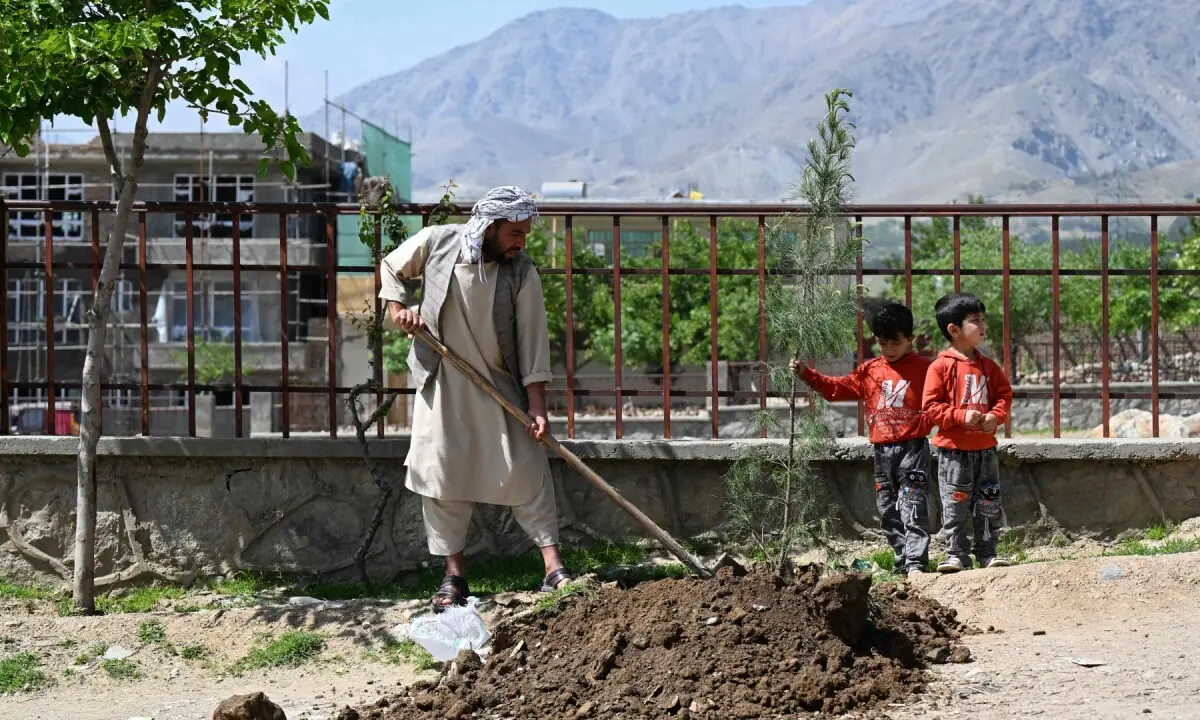
KABUL: Across Afghanistan, communities, officials and aid groups are stepping up tree planting efforts as the country tries to recover from decades of wartime deforestation that wiped out large areas of forest and pistachio woodland.
In Char Bagh, village leader Ghulam Ali Poya said residents are again recognising the importance of trees after years in which conflict accelerated logging. Speaking about the mountains around the village, he recalled that pistachio forests once covered the area before they were cut down during war and civil strife.
Mohammad Nasir Shalizi, a researcher at North Carolina State University, said about 50 per cent of Afghanistan’s forest cover was lost between the 1979 Soviet invasion and the fall of the first Taliban government in the early 2000s. He said timber smuggling to Pakistan caused extensive logging in the east, while in the drier central and northern pistachio-growing belt, people relied on wood for heating and cooking.
Shalizi said deforestation has slowed substantially over the past two decades. According to the National Statistics and Information Authority, forest cover has risen 35pc nationwide since 2011. Even so, only 2.5pc of Afghanistan was forested in 2025, and tree cover is still declining in some areas.
Community projects and planting drives
Experts told AFP that communities are trying to improve forest cover, with both the former US-backed government and the current Taliban administration having backed plantation campaigns. In Char Bagh, the Aga Khan Development Network funded a one-square-kilometre grove containing poplars, paulownias, pomegranates and persimmons.
The land belongs to farmer Bas Begum Ahmadi, who hopes the trees will eventually help her earn income through fruit and homemade jam. The site is also open to the local community of 350 families. Ahmadi, 45, tends the trees with her husband as they support their four children.
The grove was developed as a micro-forest based on the principles of Japanese botanist Akira Miyawaki, with dense planting of mostly local species of different heights. The area is cooler than the surrounding bare fields and also provides twigs for fuel and leaves used as livestock fodder.
Parisa Malikzada, Afghanistan agriculture coordinator for the Aga Khan Development Network, said micro-forests help restore ecosystems, improve soil fertility, strengthen climate resilience and support livelihoods. She said the organisation has established 500 micro-forests in seven provinces.
Poya said the Char Bagh forest, located beside a river, helps reduce soil erosion during floods and serves as an example for other people in the area. He said many visitors come to see it and want to create similar spaces.
Targets, challenges and protection measures
Afghan authorities have set a target of planting 200 million trees from 2023 to 2030, with support expected from non-governmental organisations, the United Nations and the private sector. Rohullah Amin, head of climate change at the General Environmental Protection Agency, said the target for last year was eight million trees, but 17 million were planted. He said this year’s goal is nine million.
Amin said the campaign faces several obstacles, including the need to choose native species suited to local conditions, shortages of water and damage caused by grazing animals. He acknowledged that some forests had suffered from poor care or inadequate irrigation, and said drought killed 70pc of the pine trees planted at one site.
In some areas, tribal councils are protecting forests and fining residents who damage them. In others, forest management associations made up of elected villagers and farmers have been established. Muhammad Safi, climate change chief at the UN Food and Agriculture Organisation, said the FAO has helped plant five million trees since 2019.
Nurseries and changing attitudes
The government has also set up nurseries on state land, including in Paghman on the outskirts of Kabul, to grow local species for distribution around the country. Head gardener Mahmood Khwajazada oversees almond, pine nut and walnut trees as well as deodar cedars at one such nursery.
Referring to a religious teaching to encourage planting, Khwajazada told AFP:
"Our Prophet said, ’Even if you have only one day left, plant a tree,"In Charikar in northeastern Afghanistan, where thousands of saplings were planted this year along roads, in parks and on hillsides, the municipality says public attitudes toward trees are changing. Resident Ahmad Khalid Sabiri said he volunteered in the campaign because he believed it would benefit the environment.
Experts said that while plantation drives are expanding, more effort is still needed to safeguard remaining old-growth forests and to focus tree planting inside forest areas rather than limiting it mainly to urban spaces.
Comments
No comments yet. Be the first to join the discussion!


