Wildfire scorches more than 3,000 hectares of forest in Kotli Sattian
A major wildfire in Kotli Sattian has destroyed 3,326.4 hectares of forest cover across 27 locations, according to satellite analysis. Officials and residents said strong winds, extreme heat and limited firefighting resources worsened the damage.

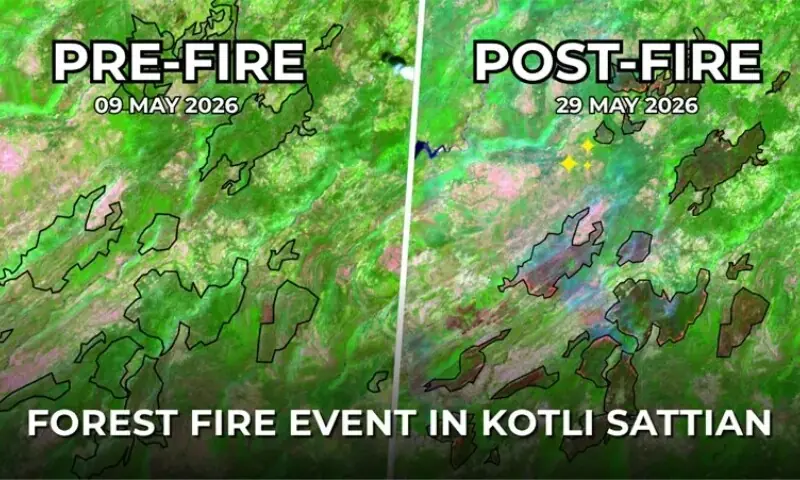
ISLAMABAD: A major forest fire in Punjab’s ecologically sensitive Kotli Sattian region has destroyed an estimated 3,326.4 hectares of natural forest cover across 27 locations, according to satellite analysis cited in official accounts and local testimonies.
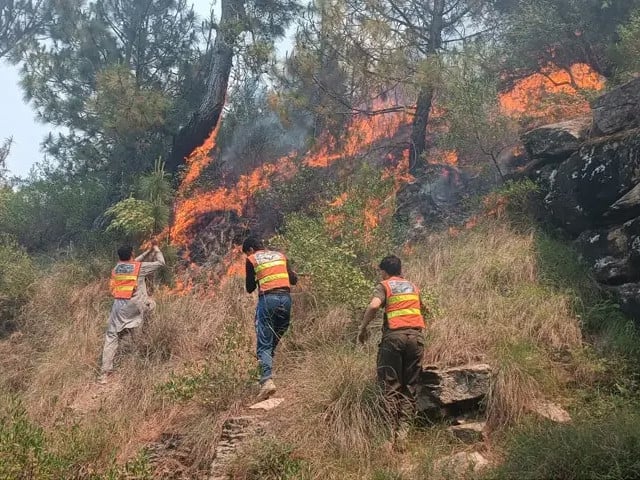
The blaze burned for two days and swept through Chir pine forests in the protected area, with local residents and forest staff describing difficult efforts to stop it from spreading. According to satellite data released by Suparco on Space4Climate.gov.pk, imagery comparing May 9 and May 29 showed extensive damage in the area’s pine forests, which help protect sub-watersheds connected to the Indus and Jhelum river basins.
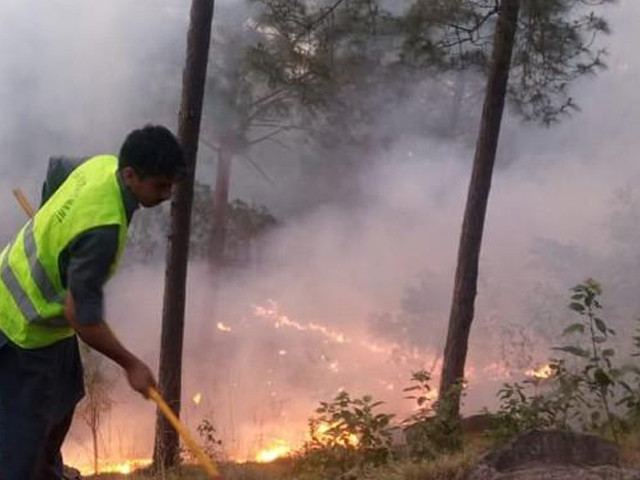
Among those caught near the flames was Fareha Yousaf, who said she, her husband, two daughters and five to six staff members tried to keep the fire from reaching their home in Karore village. Images and videos she shared showed family members and staff removing dry pine needles and shrubs while others used plastic mugs to throw water from buckets onto the flames. She said the heat from the ground and the smoke made the experience extremely severe.
In remarks describing the ordeal, Yousaf said the fire came up to the small fence around her house and left the family shaken. “The ground was so hot that I could feel my feet burn,” Ms Yousaf said.
She also said inhaling smoke caused a burning sensation inside, and added after the fire was extinguished near her home: “We are all so scared that even though the fire has been put out, the fear is not going away.”
Firefighting challenges and suspected cause
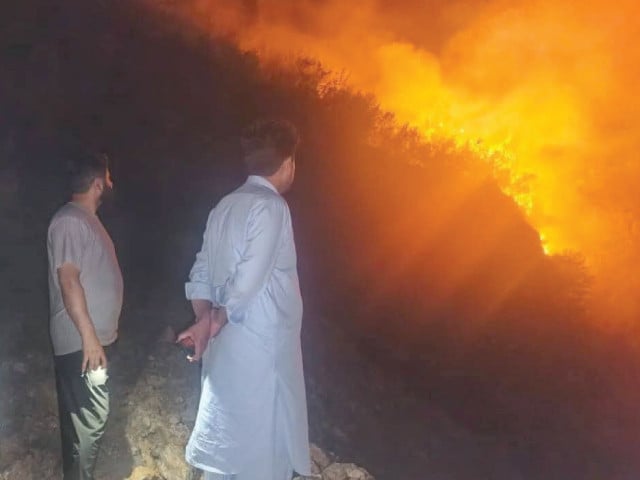
Forest Inspector Mohammad Tufail of the Punjab Forest Department told Dawn that the flames rose as high as 100 feet, driven by strong stormy winds. He said the fire in his jurisdiction, identified as Forest 99, was believed to have been caused by human action, adding that no such fires had occurred there since 2016-17.
“These are educated people, quite sensitised about risks and consequences of triggering forest fires. It’s lamentable that anyone would act so carelessly,” he said.
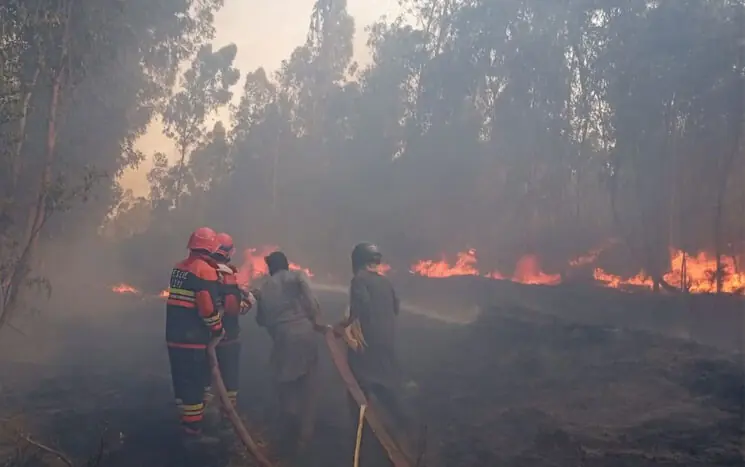
He also complained of limited resources for tackling the blaze, saying forest officials lacked proper firefighting equipment and sufficient manpower. “We were less than a dozen forest staff members with brooms to put out flames that were engulfing Pine trees and dry shrubs fast,” he said.
Although local communities and forest department personnel managed to control the fire in several locations, active flames were still spreading over nearby slopes because of strong, hot winds, threatening further environmental damage.
Environmental impact and official warning
The Ministry of Climate Change and Environmental Coordination said the Kotli Sattian fire destroyed more than 3,000 hectares amid a heatwave. The ministry said such fires affect the breeding season of birds and animals, damage the regeneration of seedlings and saplings, and encourage the spread of invasive grasses and shrubs that can tolerate fire. Environmentalists similarly warned that the effects would extend beyond the immediate burnt area, disrupting peak breeding season for local wildlife and opening damaged land to invasive species.
Mohammad Saleem, spokesperson for the ministry, told Dawn that the wildfire was not an isolated incident but a warning about changing climate conditions in Pakistan. “Forest fires are increasingly becoming the ‘new normal’ across the country as rising temperatures, prolonged dry spells, erratic rainfall patterns and recurrent heat waves create ideal conditions for ignition and rapid fire spread.”
Saleem said scientific studies showed that climate change was intensifying extreme heat across South Asia, with Pakistan among regional hotspots facing increasingly severe and synchronised heatwaves. He said these conditions dry vegetation and reduce soil moisture, increasing the likelihood of wildfires. He also referred to findings cited from Nature Communications and the World Resources Institute indicating that global warming is expanding fire-prone areas, extending fire seasons and increasing tree-cover loss worldwide.
He said the future of Pakistan’s forests would depend not only on policy and equipment but also on local vigilance. “Local communities are the frontline protectors of our forests, and investing in their engagement, training and ownership is among the most effective defences against the growing threat of wildfires,” he added.
According to locals, Kotli Sattian is being promoted by the local government as an emerging tourist destination because of its natural scenery, the Bisa waterfall and camping sites. The area remains environmentally sensitive as the Murree-Kotli Sattian landscape is marked by Chir pine forest, steep slopes and sub-watersheds linked to the Indus and Jhelum basin. The Kotli Sattian forest area under the Punjab Forest Department covers about 27,653 acres.
Comments
No comments yet. Be the first to join the discussion!