Farmers pin hopes on budget despite deepening worries
Farmers and agricultural experts are urging the government to set a clear policy direction in the upcoming budget amid rising costs, wheat policy reversals and persistent water shortages. They say inconsistent interventions are undermining farm profitability and survival.

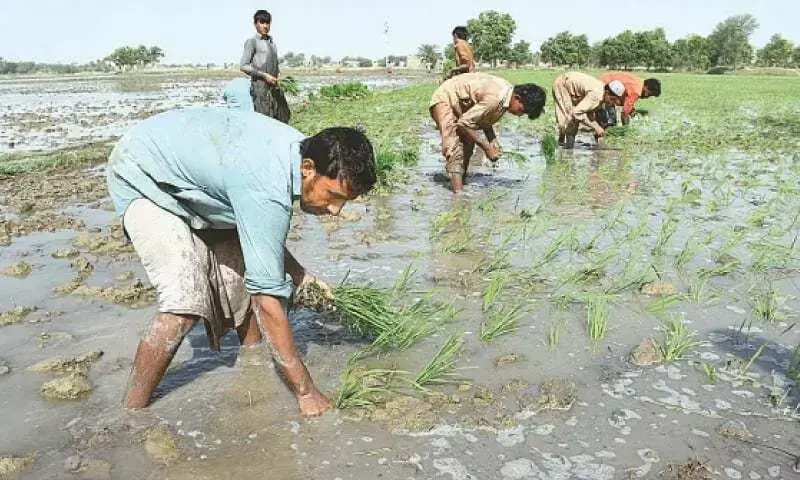
ISLAMABAD: Farmers and agricultural experts are looking to the upcoming budget for a clearer direction on farm policy, amid mounting concern over rising input costs, shifting wheat policies and worsening water shortages.
The concerns, as outlined by growers and sector specialists, centre on what they describe as repeated policy reversals in subsidies, procurement pricing, input-cost liberalisation and agricultural trade. They argue that the absence of a stable long-term framework has steadily eroded profitability and pushed the sector into deeper uncertainty.
Deregulation of farm inputs has continued to drive up production costs, while the government has been reluctant to allow those higher costs to be passed on to consumers because of political considerations. Farmers say this combination of liberalised input prices and controlled output prices has made farming increasingly unviable.
Iqrar Ahmad Khan, former vice chancellor of the University of Agriculture Faisalabad and author of the Punjab government’s last agricultural policy, said the government now had to make its direction explicit in what would be its third budget.
“After all, this is going to be the third budget of this government; it must decide where it wants to take the sector. If it wants to regulate agricultural inputs and trade, it should do so clearly. If it plans to deregulate, it must do so unambiguously. But it must make the direction clear. If deregulation is the preferred path, as appears to be the case, then the government should stop interfering in the market on behalf of different stakeholders — whether farmers, consumers, traders or manufacturers — at different levels and times, and let the market find its own equilibrium,” he added.
Wheat policy reversals
Farmers cited wheat as the clearest example of what they see as inconsistent policymaking. The federal and provincial governments had stepped back from wheat procurement two years ago in response to lenders’ demands. But after a sharp collapse in prices last year, the Punjab government attempted to attract commercial wheat buyers by assuring them it would share their financial burden and protect profitability.
When that model began to falter within weeks, the province moved back to administrative intervention, including raids on farmers’ stocks, confiscation of wheat shipments on roads and the use of official powers to build reserves for private buyers. Farmers say they were hit both by the state’s withdrawal from the wheat market and by later actions to shore up a struggling liberalisation model.
Structural weaknesses
Some experts say the sector’s difficulties go beyond pricing and procurement and reflect long-standing structural problems. Dr Asif Ali, vice chancellor of Nawaz Sharif Agriculture University, said Pakistan’s highly fragmented landholdings, which continue to be divided from one generation to the next, require mitigation through cluster farming and crop zoning.
He said such clusters could be connected with suppliers of quality seed, fertiliser and pesticides, while those providers could also train farmers. He added that the model could improve agricultural marketing as well.
Dr Ali also pointed out that nearly 65pc of farmers hold less than five hectares of land. For these growers, he said, mechanisation is often either too costly or not commercially practical. He proposed that the budget include steps to establish farm machinery rental centres so small farmers could use equipment without having to purchase it outright.
Profitability and survival
Farmers’ representatives, however, say the most immediate issue is survival. Khalid Khokhar of the Pakistan Kissan Ittehad called for urgent measures to restore profitability, arguing that agriculture is no longer economically sustainable.
He proposed a pricing commission that would calculate crop-wise production costs each year, add a 25pc profit margin and announce prices before crops reach the market.
“Either put a cap on the cost of inputs or remove the cap on the price of outputs,” he warns. “Otherwise, farmers may soon be pushed out of business and existence,” he warned.
Water shortages and funding gap
Water availability remains the sector’s most serious challenge. Data from the Indus River System Authority show water shortages stayed in double digits in six of the last 10 years and reached nearly 30pc in 2022-23. None of those 10 years was free from a water shortfall.
Naeem Hotiana, a farmer from central Punjab, highlighted what he described as a major mismatch between financial needs and actual allocations for water projects. He said the outgoing Wapda chairman had sought Rs400 billion a year to complete ongoing projects but received only Rs35 billion, which he said was less than 10pc of the requirement.
“The irrigation system was originally designed for 65pc land utilisation, whereas the current cropping intensity in Punjab has already crossed 150pc. Now combine the realities of limited surface-water availability, shrinking groundwater reserves and barely one-tenth of the required investment being provided, and imagine the situation that is emerging. Doesn’t it scare one out of one’s senses?” he lamented.
He also said the pressure would intensify further as climate-related strains increase. “Climate change, which is already testing the limits of existing water supplies, only deepens the anxiety.”
Comments
No comments yet. Be the first to join the discussion!