

Swedish palaeontologist works to recreate Jurassic-era southern Sweden
A Swedish palaeontologist and her team are reconstructing southern Sweden as it appeared around 200 million years ago. Their work draws on Jurassic-era fossils and pollen samples preserved in Skane.

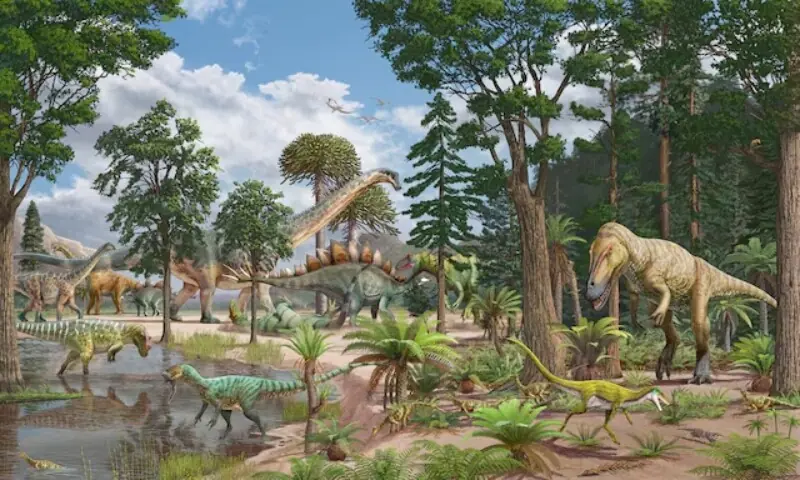
STOCKHOLM: A Swedish palaeontologist is working to reconstruct what southern Sweden looked like around 200 million years ago, when the area was covered in dense vegetation and inhabited by crocodiles and dinosaurs.
According to AFP, researcher Vivi Vajda and her team are focusing on remains unearthed in Skane, a province in southern Sweden where most Jurassic-era fossils found in the country have been discovered.
In a section of the Museum of Natural History in Stockholm, Vajda recently showed fossil material and research samples from her office, which was filled with books and specimens. Seated at a microscope, she examined samples gathered during fieldwork in Skane and projected the images onto a wall using an overhead projector.
While presenting one of the specimens, Vajda said the material came from her own field collection. “This is a pollen sample that I collected in the field,” she said, pointing to what looks like brown and yellow spots, round and rectangular in shape.
Fossils preserved in southern Sweden
The majority of Sweden’s Jurassic fossils have been found in Skane because deep fissures in the ground helped preserve them. Those cracks shielded the remains from the ice ages that wiped out traces of that period in other parts of Sweden.
Vajda said her research centres on identifying the forests that existed during the Jurassic period. She explained that pollen offers her a way to visualise the wider prehistoric environment, not just isolated plant remains. “I’m interested in what forests there were during the Jurassic period, so when I see a pollen grain, I actually see the tree. I can see the tree and the ecosystem in front of me,” she said.
From field research to public reconstruction
The AFP report said the idea of presenting these ancient environments to the public developed gradually during Vajda’s fieldwork. As she studied rocks and fossils, she began shaping a way to show others the landscapes she imagined from the evidence in front of her.
The project is rooted in fossil and pollen analysis from Skane, where preserved remains have offered researchers a rare window into Sweden’s Jurassic past. Through that work, Vajda and her team are attempting to piece together an era when the region was markedly different from its present-day landscape.
the effort as an attempt to bring back, in reconstructed form, a time when southern Sweden supported lush plant life and roaming prehistoric animals. By studying fossil samples and microscopic pollen grains, the team is seeking to rebuild a picture of the ecosystem that existed there millions of years ago.
Vajda’s work, as described in the report, links detailed scientific examination with a broader effort to make prehistoric life understandable to the public. Her reconstruction project draws on evidence preserved in Skane’s geology and on years of field research aimed at understanding the forests and ecosystems of the Jurassic period.
Comments
No comments yet. Be the first to join the discussion!


