India raises petrol and diesel prices for first time in four years
India has raised petrol and diesel prices by 3 Indian rupees per litre, the first such increase in four years, as state-run retailers try to recover losses from higher crude prices. The move comes alongside fuel-saving measures introduced amid energy market disruption linked to the Iran war.

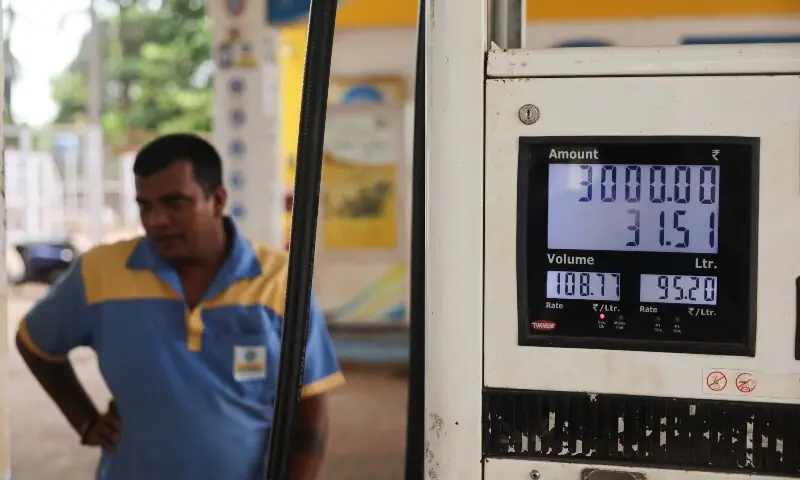
NEW DELHI: India’s state-owned fuel retailers have increased petrol and diesel prices for the first time in four years, lifting rates by 3 Indian rupees per litre, according to dealers, as companies seek to offset losses linked to higher international crude prices.
The increase comes as the war triggered by US-Israeli attacks on Iran has disrupted shipping through the Strait of Hormuz, pushing up energy costs. India, the world’s third-largest importer and consumer of oil, had been among the last major economies yet to pass on higher fuel costs to retail consumers.
State-run Indian Oil Corp, Hindustan Petroleum Corp and Bharat Petroleum Corp together operate more than 90 per cent of India’s 103,000 fuel stations and usually move diesel and petrol prices in step. A spokesperson for BPCL confirmed the increase at its retail outlets, while Indian Oil and HPCL did not immediately respond to a request for comment.
In Delhi, diesel will now be sold at 90.67 Indian rupees per litre and petrol at 97.77 Indian rupees per litre. These compare with earlier prices of 87.67 Indian rupees for diesel and 94.77 Indian rupees for petrol, reflecting increases of 3.4 per cent and 3.2 per cent respectively.
Global oil prices had climbed above $120 a barrel before easing back to around $100 to $105. Shares of Indian fuel retailers fell on Friday, with Indian Oil Corp down 2.4 per cent, HPCL lower by 3.3 per cent and BPCL down 3.6 per cent as of 0550 GMT, or 10:50am PKT.
Madhavi Arora, chief economist at Mumbai-based Emkay Global Financial Services, said the immediate effect on consumer inflation would be limited, at about 15 basis points, though the broader indirect impact would be greater.
“The hikes are not enough but could be the start of multiple staggered hikes,” she said.
Fuel-saving measures expanded
New Delhi has also introduced austerity steps aimed at reducing fuel use and containing the oil import bill as officials prepare for what they see as a prolonged energy shock.
On Sunday, Prime Minister Narendra Modi called for a series of measures including fuel conservation, work-from-home arrangements, and restrictions on travel and imports as rising global energy prices added pressure on India’s foreign exchange reserves.
Some states have this week issued notices to government departments directing them to limit travel, avoid in-person events, move meetings online and work from home two days a week, with offices operating at half strength. The measures are expected to be broadened to include millions of employees in the federal government, state-run banks and public sector companies, indicating a wider tightening of spending and operations as financial risks increase. The government did not respond to a Reuters email seeking comment.
Demand outlook revised
Analysts said the latest increase remains relatively small and leaves room for further upward revisions if retailers are to recover revenue losses.
“India’s petrol demand growth will be impacted, although the price hike is modest, but other fuel conservation steps, such as work from home, will dent demand growth,” said Prashant Vashisth, vice president and co-head of corporate ratings at Moody’s Indian arm, ICRA Ltd.
ICRA has cut its forecast for gasoline demand growth this year to 3pc-4pc from an earlier 5pc-6pc. For gasoil, or diesel, it now expects flat growth instead of the previously projected 2pc-3pc increase.
Analysts and opposition parties said state-run retailers had held back price increases during key state elections. Those polls concluded this month, with Modi’s Bharatiya Janata Party winning two of four states and extending its influence.
Oil ministry official Sujata Sharma said in April that after the war began, higher oil prices were causing Indian retailers to lose about 100 Indian rupees per litre on diesel and about 20 Indian rupees per litre on petrol. In late March, Russia-backed private refiner Nayara Energy had already raised pump prices to reduce some of its retail losses.
Comments
No comments yet. Be the first to join the discussion!