

May 7, 2026
Punjab completes restoration work on parts of Derawar Fort
The Punjab archaeology department says restoration work worth over Rs120 million on parts of Derawar Fort has been completed. Officials say the renovated sections may be opened to visitors in due course.

May 7, 2026
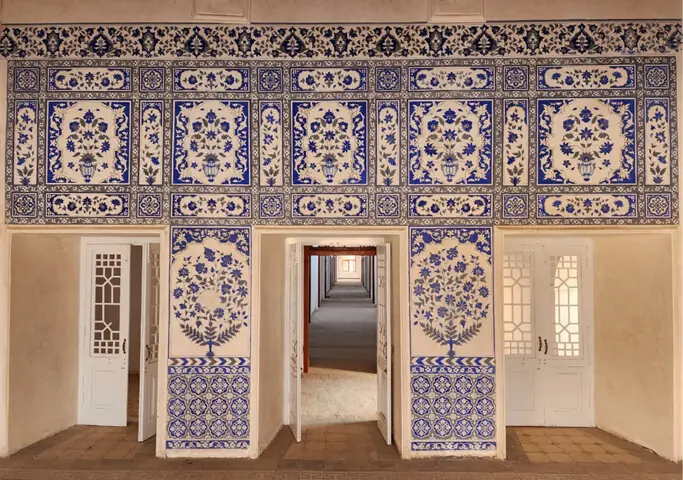
BAHAWALPUR: The Punjab archaeology department has said it has completed a restoration and conservation project worth more than Rs120 million at parts of the historic Derawar Fort in the Cholistan desert, around 70 kilometres from Bahawalpur.
According to the department, the work covered sections of the late Nawab of Bahawalpur Sadiq Muhammad Khan Abbasi V’s secretariat and residential area inside the fort. The project also included restoration of a fortification wall near the late Nawab’s civil buildings. The work was undertaken during 2022-23.
Archaeology department Sub-Divisional Officer Sajjad Ahmed told Dawn on Wednesday that the restored portions of the historic structures had been completed and could be opened to visitors in due course.
He said both buildings had been finished using modern tiles and materials while retaining their original architectural character.
The official also said the department had previously completed restoration work on the fort’s eastern bastions, fortification wall, a platform, Baradari, main gate, godown and the historic mosque at a cost of Rs141.895 million under the project.
Historic significance
Derawar Fort is regarded as one of the defining landmarks of the Cholistan desert and draws a large number of tourists and visitors each year. It is described as an architectural masterpiece and is said to have originally been built by Rai Jajja Bhatti of Jaisalmir in the 9th century A.D.
Historical accounts cited in the report say the present structure was built in 1733 A.D. by Nawab of Bahawalpur Sadiq Muhammad Khan-I. The fort remained under the control of the ruler of the former Bahawalpur State until 1966.
The fort is a massive structure laid out almost in a square plan. Its walls and 39 high bastions were constructed with small burnt bricks on the inner and outer facades, while sun-dried bricks of the same size were used in the central core. Mud mortar was used throughout the masonry as the binding material.
Protected monument
Because of its historical and architectural importance, the archaeology department declared the site protected in 2005 under the Antiquities Act 1975. It was later placed on Unesco’s Tentative World Heritage List in 2016.
After the death of Nawab Sadiq Muhammad Khan Abbasi V in 1966, the fort began to fall into disrepair due to a lack of maintenance. In recent years, the archaeology department and the Bahawalpur divisional administration had allocated funds from time to time for preservation and restoration of deteriorating sections of the fort.
The latest restoration is part of those continuing efforts to conserve one of southern Punjab’s most prominent historic sites.
0 Comments
No comments yet. Be the first to join the discussion!


