

KP Assembly takes up bill to register Kalash marriages
PESHAWAR: The KP government has tabled the Kalash Marriage Bill 2026 in the provincial assembly to provide legal recognition to Kalash marriages and customary rites. The proposed law has been sent to a committee for review before final approval.

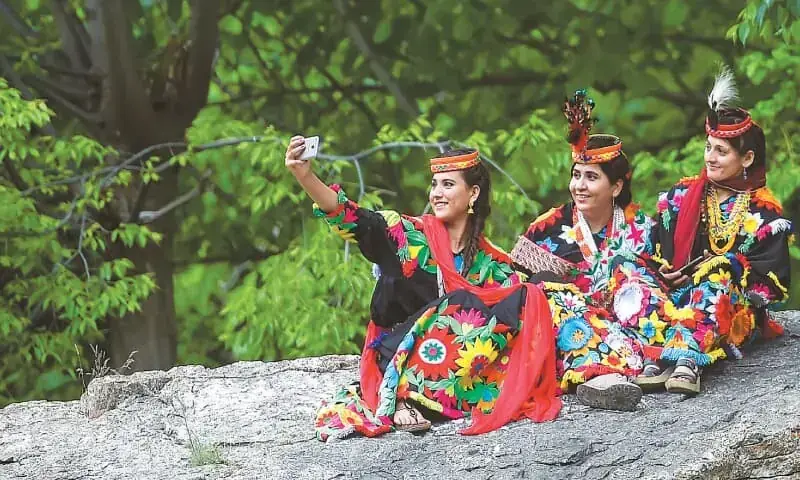
PESHAWAR: The Khyber Pakhtunkhwa government has introduced a bill in the provincial assembly aimed at providing a legal framework for the solemnisation and registration of marriages within the Kalash community, including a minimum marriage age provision and recognition of customary practices.
The proposed law, titled the Kalash Marriage Bill 2026, has been tabled in the KP Assembly and referred by the speaker to the relevant committee for detailed review and consultation before final approval.
According to the bill, the legislation seeks to give legal recognition to Kalash marriages, customs and customary rites, and would apply to citizens of Khyber Pakhtunkhwa who profess the Kalash faith. The Kalash community, numbering more than 4,000 people, lives in the remote valleys of Bumburet, Birir and Rambur in Chitral district.
Marriage conditions and customary practices
Section 5 of the proposed legislation lays down the conditions for solemnisation of Kalash marriages. It says the couple must be of sound mind, capable of giving valid consent, have attained the minimum age of 17 years, and must not fall within prohibited degrees of relationship.
The report also said the measure makes 18 years the prohibitory age for both males and females for contracting marriages.
Section 6 gives legal cover to the Kalash custom of shisha-istongas, described in the bill as a process of cleansing and purification between a couple. Under the proposed law, once the maraat ceremony — a wedding feast hosted by the husband’s family for the wife’s family — is performed, the couple enters into shisha-istongas, which would be treated as a valid marriage within the community.
Section 7 states that a marriage under the alashing custom, described as a special form of marriage, would be considered valid where a Kalash girl marries a Kalash man of her own will without prior consent, provided that before consummation of the marriage, the girl’s parents or close relatives visit her in-laws’ home to verify and confirm her consent and happiness.
Under Section 8, once the girl’s consent is confirmed by her parents or close relatives, the husband’s family offers the maraat to the wife’s parents and relatives and sees them off with gifts and presents according to its financial means. Acceptance of the maraat by the wife’s parents or close relatives is treated as confirmation of the marriage.
Section 9 provides for the appointment of marriage registrars. It says the concerned local government shall, through notification, appoint one or more marriage registrars at the village and neighbourhood council levels.
Divorce provisions and community response
Section 16 of the bill deals with divorce. It states that where a husband gives divorce, referred to as ja jhutik, of his own free will, he would not be entitled to any compensation from the wife or her parents, nor to any dowry, articles or gifts given at the time of marriage or afterwards.
It further states that if a woman refuses to live with her husband, referred to as ja-parik, the wife’s parents would be bound to refund in cash or kind the cost borne by the husband on the marriage, after deducting the value of items and gifts given by the wife’s side to the husband’s side during the marriage ceremonies.
Welcoming the move, Wazirzada, focal person to the chief minister on minority affairs and a member of the Kalash community, called the bill a historic development.
“For the first time, our marriages and family systems are being formally recognised within the legal framework of the province, without compromising our centuries-old traditions. It is a step towards dignity, protection, and identity for our community,” he said.
Qamar Naseem, programme manager at Blue Veins and one of the key drafters of the bill, said the legislation had emerged from a broad consultative process involving religious figures, qazis, local government representatives, and men and women from the Kalash community.
“The bill has been developed through a comprehensive process of consultations involving the Kalash clergy, Qazis, local government representatives, and both men and women from the community. It reflects existing customs and has been endorsed by relevant community stakeholders,” he said.
He added that the marriage-related provisions were based on long-standing Kalash traditions that discourage marriages within seven generations of the paternal lineage.
“The bill does not impose any new restriction but formally recognises and codifies these established cultural practices within a legal framework,” he added.
Comments
No comments yet. Be the first to join the discussion!


