Pakistan's defense agreement with Saudi Arabia is hailed as a historic milestone, enhancing regional security amid rising militant violence and solidifying decades of cooperation.
- UN envoy Asim Iftikhar Ahmad calls Saudi-Pakistan defense agreement a ‘historic milestone,’ saying it formalizes decades of military cooperation, enhances joint deterrence
- Ahmad highlights Pakistan’s success against TTP and BLA despite militant resurgence from Afghanistan
- Reiterates firm stance on Gaza, supports full implementation of UN Resolution 2803
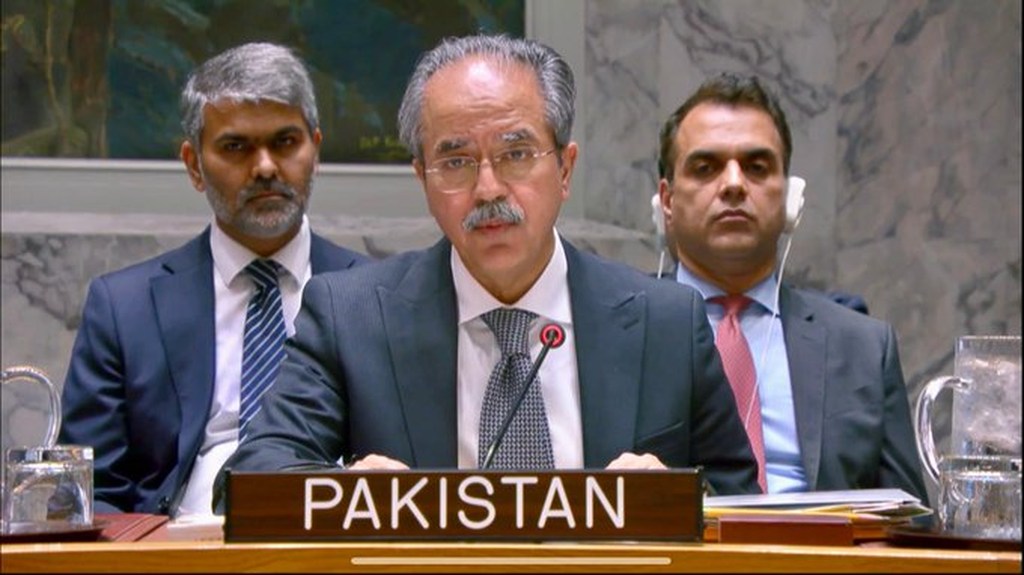
NEW YORK CITY: Pakistan’s Permanent Representative to the United Nations, Asim Iftikhar Ahmad, has hailed his country’s strategic partnership with Saudi Arabia, describing the recently signed defense cooperation pact as historic and central to regional security amid rising militant violence.
“This agreement is highly significant, but it should be seen as a continuation and consolidation of decades of cooperation and a strong strategic alliance between Saudi Arabia and Pakistan,” Ahmad said in a wide-ranging interview with Arab News at UN Headquarters in New York.
Rooted in “brotherly ties and strategic alignment on regional and global issues,” he added, the partnership has now been formalized and “placed into concrete shape.”
Strategic defense and economic ties
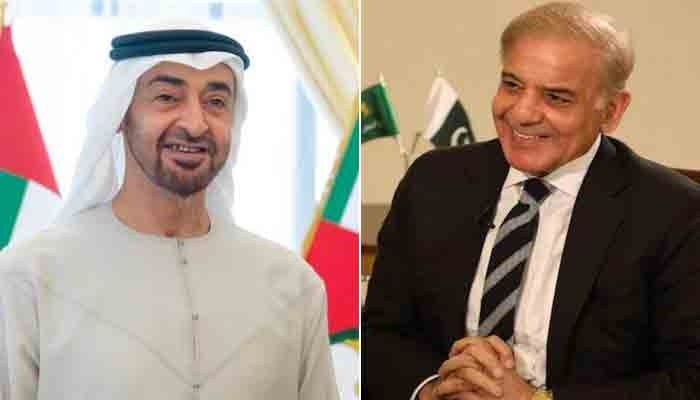
Pakistan and Saudi Arabia signed a Strategic Mutual Defense Agreement on September 17 last year, pledging that aggression against one country would be treated as an attack on both. The pact formalizes decades of military and security cooperation while enhancing joint deterrence. The agreement was signed during Prime Minister Shehbaz Sharif’s state visit to Riyadh, where he met Crown Prince Mohammed bin Salman at Al-Yamamah Palace.
Ahmad highlighted that the defense pact was complemented by an economic cooperation framework, reflecting a comprehensive bilateral engagement. “Saudi Arabia is a major economic partner for Pakistan,” he said, pointing to growing trade, investment, and development cooperation.
He also emphasized the deep public and spiritual bond between the two nations, citing Saudi Arabia’s custodianship of Islam’s holiest sites. “It’s not just government-to-government relations. The people of Pakistan have immense respect for Saudi Arabia,” he noted.
Countering militancy
The strengthened ties with Riyadh come as Pakistan confronts a renewed wave of militant attacks aimed at destabilizing the country. “These terrorist incidents are a continued attempt to undermine Pakistan’s peace and stability, and to reverse its economic recovery and growing international profile. But we will tackle them effectively,” Ahmad said.
He identified the Tehreek-e-Taliban Pakistan (TTP) and the Balochistan Liberation Army (BLA) as the primary groups attempting to create instability. “Over the years, Pakistan has successfully countered terrorist and militant networks,” he said, adding that the Taliban’s return to power in Afghanistan in August 2021 has allowed these groups to regroup, train, and plan attacks across the border.
Pakistan has raised the issue both bilaterally and at multilateral forums, including the UN Security Council, citing monitoring reports that highlight the presence of TTP elements and the permissive environment in Afghanistan. “We have the capability to address this threat. Many of these elements have already been neutralized,” Ahmad said, noting that billions of dollars’ worth of abandoned military equipment left behind by international forces has fallen into the hands of terrorist groups.
Economic progress under attack
Ahmad stressed that Pakistan’s economy has improved significantly through reforms, IMF-linked measures, and bilateral engagement. “Macroeconomic indicators are pointing in the right direction, and we are actively improving the investment climate. China remains engaged through the CPEC, Saudi Arabia is exploring major investments, and we are expanding relations with the UAE, Qatar, Turkey, and the US,” he said.
He linked recent militant attacks directly to Pakistan’s rising economic and diplomatic profile. “These incidents are a deliberate attempt to undermine Pakistan’s progress, its growing role at the UN, and the enhanced profile following the recent conflict with India,” he said.
Gaza and international diplomacy
On Gaza, Ahmad reiterated Pakistan’s firm condemnation of Israel’s repeated violations of the ceasefire and international law. “Our position is clear in the Security Council, the General Assembly, and from our leadership. We are deeply concerned by these continuing violations,” he said.
He recalled Pakistan’s role alongside the Organization of Islamic Cooperation (OIC) and Arab partners in supporting US President Donald Trump’s 20-point Gaza peace plan and securing UN Security Council Resolution 2803. “Our collective expectation, with partners like Saudi Arabia, Qatar, and Turkey, is that the plan be implemented fully and in good faith — first to achieve a permanent ceasefire, and then to enable reconstruction,” he said.
Ahmad emphasized that the ultimate goal is political: “There has to be movement on the political track leading to an independent Palestinian state. That is our principle and ultimate objective.”
Pakistan’s global engagement
Ahmad highlighted Pakistan’s renewed diplomatic prominence, noting its contributions to UN peacekeeping, peacebuilding, and preventive diplomacy. Regionally, Pakistan seeks a “peaceful and stable Afghanistan,” supports a diplomatic solution to the Iranian nuclear issue, and maintains strong relations with China.
“At the UN, Pakistan works actively through the OIC, G77, the Non-Aligned Movement, and other forums to strengthen multilateral cooperation,” he said.
Addressing the UN’s financial challenges and calls for reform, Ahmad rejected any notion of collapse. “The UN is here to stay. Most member states continue to have great faith in multilateralism. Reform is necessary, but it must make the UN stronger, more effective, and responsive to its members,” he said.
He stressed that financial problems largely stem from unpaid member contributions. “The issue is not with the UN itself, but with member states not fulfilling their obligations. There is no viable alternative to the UN, and our commitment to multilateralism remains strong,” Ahmad added.