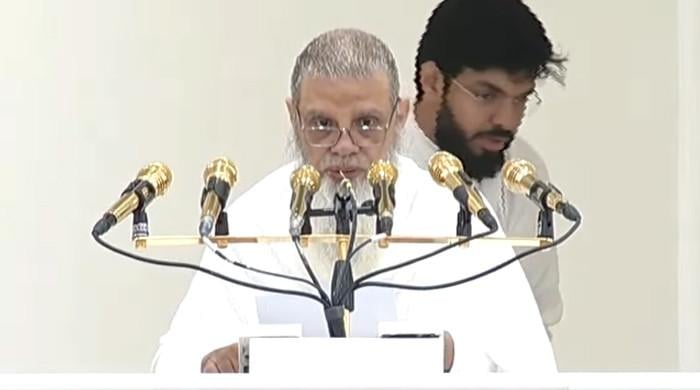
Grand Mosque Imam urges compassion, solidarity with Palestine in Hajj sermon

- Sheikh Dr Saleh asks Muslims to uphold Islam’s five pillars, virtues like patience, and avoid new practices in Islam
- Good and evil are not the same. Responding to harm with goodness can turn enemies into friends: grand Imam
- Pilgrims begin making their way to Muzdalifah for Friday’s symbolic ‘stoning of the devil’
MAKKAH: Imam of Makkah’s Grand Mosque Sheikh Dr Saleh bin Abdullah bin Humaid delivered a spiritually charged sermon on Thursday during the annual Hajj pilgrimage, calling for unity, piety, and compassion—while offering heartfelt prayers for the people of Palestine.
The sermon took place at Masjid Namirah in Arafat, where over 1.5 million pilgrims from across the globe gathered to perform Waqoof-e-Arafah, the central rite of Hajj. The Day of Arafat is considered the holiest day in the Islamic calendar, a time when believers seek divine forgiveness and draw spiritually closer to God.
In his address, Sheikh Humaid focused on the core themes of Tawheed (the oneness of God), sincere worship, and moral conduct. He reminded Muslims that worship is due to Allah alone and that no prophet or righteous person should be venerated in place of the Creator.
On the other hand, hundreds of thousands of Muslim pilgrims gathered on the outskirts of Makkah at Jabal al-Rahmah, also known as Mount Arafat, where Prophet Muhammad (PBUH) delivered his last sermon, as part of Haj rites as the holy week nears its completion.
Carrying colorful umbrellas to protect themselves from the sweltering heat, the pilgrims could be seen walking on foot to make their way to the top of the mountain, where they would sit and pray before moving on to the stoning ritual at Muzdalifa, halfway between Mina and Arafat.
Speaking to AFP, one of the pilgrims from Pakistan said, “I’ve been trying to get here… for the past 3 years,” adding that he feels blessed to be there.
Many pilgrims rushed to get there early so they could avoid the scorching heat. This year, authorities have mobilised more than 40 government agencies and 250,000 officials, doubling their efforts against heat-related illness following the lethal heatwave of 2024 in Saudi Arabia that claimed the lives of 1,300 pilgrims.
The world’s largest gathering kicked off on Friday as Muslims from all over the world poured into Saudi Arabia. One of the five fundamental pillars of Islam, Haj is performed every year in Makkah with millions of pilgrims travelling to the holy land to partake in the ritual.
The Imam of Makkah’s Grand Mosque emphasized Islam’s fundamental pillars—prayer (salah), fasting (sawm), almsgiving (zakat), and pilgrimage (Hajj)—urging believers to uphold virtues such as patience, modesty, truthfulness, and gratitude. He called for kindness toward parents, neighbours, orphans, widows, and the underprivileged, warning against spiritual and moral dangers including gossip (gheebah), religious innovation (bid’ah), and Satan’s deception.
“Good and evil are not the same,” he said. “Responding to harm with goodness can turn enemies into friends.”
The Imam also reaffirmed belief in all prophets, emphasizing that Prophet Muhammad (peace be upon him) was sent as a mercy to all of humanity, with his coming foretold in earlier scriptures.
In a poignant moment, Sheikh Humaid prayed for the suffering people of Palestine, calling on Muslims to support the oppressed, feed the hungry, and give generously in alms. His words come amid ongoing conflict and humanitarian crisis in the region.
Expressing deep appreciation to the Saudi leadership, the Imam commended the Kingdom’s efforts in organising and facilitating the pilgrimage for millions of worshippers.
Way to Muzdalifah for Friday’s symbolic “stoning of the devil”
Late on Thursday afternoon, pilgrims began making their way to Muzdalifah, halfway between Arafat and the sprawling tent city of Mina, where they will gather pebbles for Friday’s symbolic “stoning of the devil”.
Despite the heat, they were generally delighted to be performing the Haj.
“I don’t think about the sun or the temperature or anything like that,” said Ahmed, a 44-year-old from Egypt. “Because standing in Arafat is a great thing and a beautiful day, and as you can see, all the pilgrims” are doing it.
Pilgrims holding umbrellas to protect themselves from the heat walk toward Saudi Arabia’s Mount Arafat, also known as Jabal al-Rahma or Mount of Mercy, during the climax of the Haj pilgrimage on June 5. — AFP
Ali, 33, from Pakistan, said he felt “blessed” to take part.
“This is something that I used to see every year on the TV screen during Haj and I always thought: ‘I wish I could be here’,” he said.
Through tears of joy, Iman Abdel Khaleq said she had wanted to perform the Haj for 10 years and was overwhelmed with emotion as she arrived at Arafat.
“It’s a big dream for me that I had almost given up hope of realising,” the Egyptian woman in her 50s told AFP from the foot of the mountain.
High-tech Haj
Saudi officials said the heat-mitigation measures implemented this Haj had largely been successful in preventing a repeat of last year.
“We are encountering a limited number of heat-related illnesses cases this year and this is evidence of the effectiveness of all the organisation measures as well as preventive measures,” said Mohammed Al-Abd Al-Aali, Saudi Arabia’s assistant minister of health.
Along with the anti-heat measures and thousands of extra personnel, Saudi Arabia is also using an arsenal of high-tech tools to help better manage crowds.
More than 15,000 cameras run through artificial intelligence software are monitoring the holy sites and walkways during an event that has a history of deadly stampedes.
This year, officials have also clamped down hard on unregistered pilgrims looking to sneak into Makkah, using raids, drone surveillance and a barrage of text alerts.
Late on Thursday, a Haj ministry source said the moves had helped stave off overcrowding at the holy sites so far.
Haj permits are allocated to countries on a quota basis and distributed to individuals by a lottery. But even for those who can obtain them, the steep costs prompt many to attempt Haj without a permit, even though they risk arrest and deportation if caught.
Comments
No comments yet. Be the first to join the discussion!