- Tight budget might take the country down
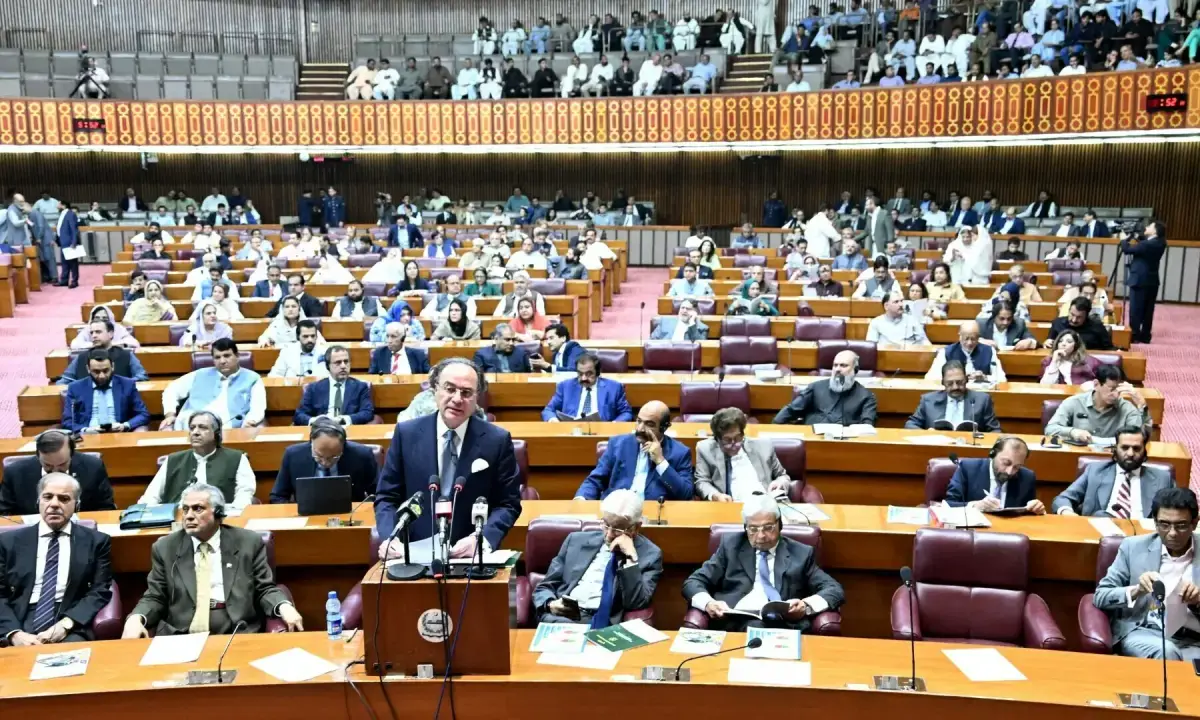
A tax-free budget for the next fiscal year with a total outlay of 7.3 trillion rupees was presented in the National Assembly by Minister for Industries and Production Hammad Azhar on Friday.
The present budget comes at a time when the economy is highly under stress due to covid-19 spreading like wildfire. The way the government failed to achieve some of its major targets in the last budget despite there being no pandemic in the country for the first nine months, does not inspire confidence in its ability to achieve the targets defined for FY 2020-2021.
The budget fails to come up to the expectation of the common man. After the concern shown by the Prime Minister about the livelihood of the people, one had expected that the government would spell out credible measures to save as many jobs as possible. There is no provision for those losing jobs on account of the economic slowdown and closure of so many businesses.
The amount of Rs 20 billion allocated to improve the capacity of health institutions, production of health equipment and provision of better health services is inadequate at a time when the number of confirmed pandemic cases has already crossed 130,000 while the virus is supposed to attain its peak in late July or early August. The damage done to the life and livelihood of the people had provided the government an opportunity to revise its priorities. The virus has proved that the country’s health system is ill-equipped, understaffed and underfunded, and therefore unable to deal with major emergencies. Much more funds should have been diverted in the budget to upgrade the health system. This has failed to happen.
The last budget had depended on the rich too much for bringing about the economic recovery, giving Rs1.15 trillion to them in tax breaks. The attempt failed to produce the desired results. One had expected that this time the government would put the money directly in the hands of the common man, thus enhancing his purchasing power which in turn would give a boost to the national economy. This too has failed to happen due to the tight fisted policy of the government.
The freeze in the military budget was inevitable on account of the steep fall in revenues. There is a need to redefine national security not only in purely military terms but also in terms of the security, health and education of the people of Pakistan as envisioned by the Quaid-e-Azam. The government deserves praise for not allowing an increase in government employees’ pays and pensions. Any increase would have looked odd at a time when millions of people were facing economic deprivation
Many had hoped that the budget would introduce measures to bring down inflation which had risen to 14.1 percent in January 2020, coming down to 9.1 percent at present. The government has failed to control the rise in prices of most of the commodities of everyday use including sugar and wheat flour. The budget has vaguely fixed the inflation rate at 6.5 percent, purely depending on hopes but without spelling out a clear policy that can ensure a reduction to the desired level.
The FBR’s tax collection target has been set at Rs 4.95 trillion after an understanding with the IMF which had earlier suggested Rs 5.1 trillion. Even this figure is difficult to achieve at a time when the large-scale industry is in bad shape and the non-tax revenue is estimated to be about Rs 1.6 trillion. This negates the finance minister’s ‘no new tax’ declaration, and implies a higher tax burden on businesses than warranted under the circumstances. There is a view that with economic growth in FY21 expected at around two percent, inflation is likely to come in at seven to eight percent, and tax elasticity of less than 1. For the budget to be tax-neutral it should have therefore ideally aimed for tax collection of no greater than Rs 4.3 trillion.