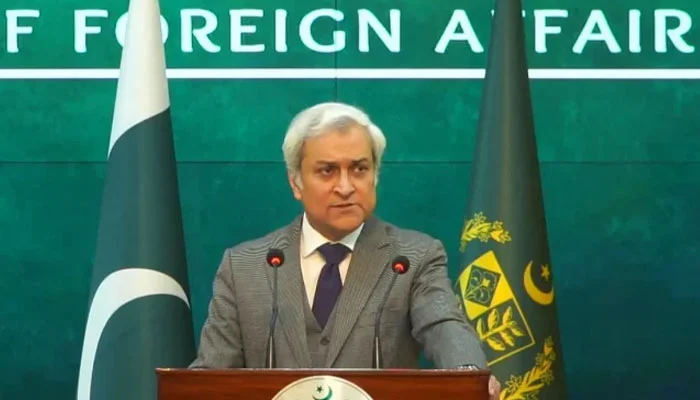

ISLAMABAD: In order to avoid getting entangled in international conflicts, Pakistan has decided against mediating between Iran and the United States but seeks immediate de-escalation of tensions between the two countries to prevent a war in the Middle East.
An informed source told Pakistan Today on the condition of anonymity that Foreign Minister Shah Mahmood Qureshi would depart on his diplomatic mission for Tehran on January 12.
“The Foreign Office (FO) is working on scheduling meetings of the foreign minister in Tehran, Riyadh and Washington over the next week. After Tehran, Qureshi would be visiting Riyadh on January 13. On January 16 and 17, the minister would be visiting Washington,” the source said.
When asked about the objective of the foreign minister’s visit to the Gulf region, the official said that the foreign minister was going with an open mind.
“He would listen to the ideas of friendly states in the thick of things and then would contemplate if we can help them come closer. But for the time being, mediation is a huge ask and we do not find ourselves fit for this task. You know even the peace deal brokered by P5 countries under United Nations (UN) had failed. So mediation is an inappropriate word for our effort,” the official clarified.
Asked why Pakistan was so eager to be the only country on earth to launch diplomatic efforts for a de-escalation between US and Iran, the official said that both Iran and US were friendly countries of Pakistan.
“We are partners in peace, not in conflicts. We do not thrive on wars. We are looking for efforts to develop and also to support regional development. Any conflict in the region would not only destabilise the region but also it would affect Pakistan,” the official said.
It merits mention here that FM Qureshi has contacted his counterparts from Iran, Iraq, Bahrain, Qatar and other gulf states and he would be soon departing for a diplomatic overture to help calm down the situation.
When asked to elaborate, the official said that any conflict between Iran and US may affect the Afghan peace process.
“You know that the US and Iran are major stakeholders in Afghanistan. So any conflict between the two may have fallout in Afghanistan. We have made tangible progress in the Afghan peace process and we want to take the Afghan peace dialogue to a logical conclusion,” the official said.
The official also said that Iran enjoyed good influence in Afghanistan and even the Afghan Taliban had a strong relationship with the Iranian government.
“You know that the US troops are present in huge numbers. We also know that groups linked to Iran may target US troops in Afghanistan. Hence, any such incident may ignite a new war in Afghanistan. Pakistan would like to see peace talks progressing in Afghanistan,” the official added.
The official further said that a regional conflict may also shift world focus from Indian Occupied Jammu (IOK) that is closely being monitored by the UN and its allied organisations as Indian state terrorism continues there.
“Indian regime right now is in a thick soup. Today is the 160th day of state curfew imposed on Kashmiris in IOK. Though Indian Prime Minister Narendra Modi’s regime staged a drama by taking some right-wing MPs from European Union (EU) to IOK but the EU distanced itself, calling it a private visit. Moreover, the visiting delegation was also not allowed to meet none of top Kashmiri leaders or the public at large and a select group of pro-regime people had met them,” the official said.
The source said that the media spotlight was also on the anti-Modi protests across India and police torture on peaceful protestors who are raising their voice against CAA and NRC laws. He said that the Modi regime was under huge domestic and international pressure right now and any regional conflict may shift the spotlight from the Indian state terrorism against its own people.
Moreover, the official said, any conflict may also have negative implications for Pakistan’s economy which was making fast progress after reforms introduced by the government.
“Any conflict in the gulf region may further raise oil prices which would badly impact our economic revival. Moreover, Pakistan has been graded as a number-one tourist destination as we are hoping for a huge number of tourists visiting Pakistan this year. Any conflict may have negative implications for tourism prospects,” he added.
The official further said that Pakistan is also pursuing a national development agenda and any regional conflict would jeopardise this objective. Pakistan has sent a clear signal to all parties involved in the conflict that Pakistan would not be a part of any regional conflict, the official added.