

Seminar highlights interdependence with China as key to Pakistan’s progress
Speakers at an Islamabad seminar said Pakistan-China ties have grown into a strong strategic partnership driven by trust and shared interests. They said Pakistan must shift from dependence to interdependence and strengthen governance and institutions to benefit fully.

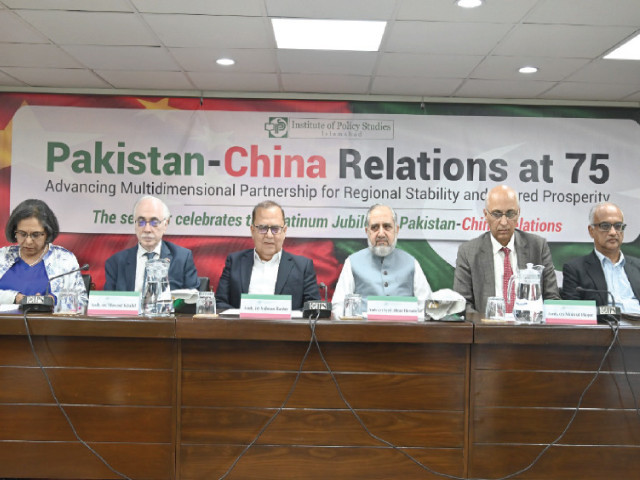
ISLAMABAD: Speakers at a seminar in Islamabad said Pakistan’s relationship with China has developed into a strong strategic partnership built on mutual trust, non-interference, and shared geopolitical interests, while stressing that economic and technological cooperation will be central to Pakistan’s future socio-economic transformation.
The discussion took place at an event titled Pakistan-China Relations at 75: Advancing Multidimensional Partnership for Regional Stability and Shared Prosperity, organised by the Institute of Policy Studies (IPS), Islamabad, to mark the platinum jubilee of diplomatic ties between the two countries.
According to the seminar’s participants, Pakistan needs a policy shift to fully benefit from its ties with China. They said the country should move from a model of dependence to one of interdependence, while also investing in better governance, stronger human capital, and greater professionalism in institutions.
Seminar participants discuss evolving ties
The session featured IPS vice-chairman Syed Abrar Hussain, former ambassador to China Salman Bashir, former foreign secretary and session chair Masood Khalid, former ambassadors Naghmana Hashmi and Moin ul Haque, and strategic affairs expert Dr Syed Muhammad Ali.
In his opening remarks, Abrar Hussain said Pakistan-China relations have changed significantly since the establishment of bilateral ties in May 1951. He said the partnership has now entered a new stage, with continued cooperation under both phases of the China-Pakistan Economic Corridor reflecting expanding engagement between Islamabad and Beijing.
The seminar focused on the broadening scope of bilateral relations as the two countries complete 75 years of diplomatic engagement. Participants linked the future of the partnership not only to strategic and geopolitical alignment, but also to practical cooperation in economic and technological fields.
Focus on governance and institutional capacity
Speakers said that if Pakistan is to draw greater benefit from the relationship, domestic reforms will be necessary. They identified governance, human resource development, and institutional professionalism as areas requiring attention in order to support a more balanced and productive partnership with China.
The discussion also underscored the view that the Pakistan-China relationship has moved beyond a traditional diplomatic framework and now carries wider implications for regional stability and shared prosperity. The seminar’s title and deliberations reflected an emphasis on multidimensional cooperation as both countries mark the 75th anniversary of their ties.
The event formed part of commemorative activities linked to the anniversary of Pakistan-China relations, with participants highlighting the continuity of engagement since diplomatic relations were established in 1951 and pointing to ongoing cooperation under CPEC as evidence of the partnership’s current trajectory.
The speakers collectively presented the relationship as one shaped by long-term trust and converging interests, while arguing that Pakistan’s own policy and institutional adjustments would determine how effectively it can translate that partnership into socio-economic gains.
Comments
No comments yet. Be the first to join the discussion!


