Nasa unveils telescope to study dark energy
NASA unveiled the Nancy Grace Roman Space Telescope, built to discover tens of thousands of exoplanets and investigate dark matter and dark energy with a wide-field infrared survey.

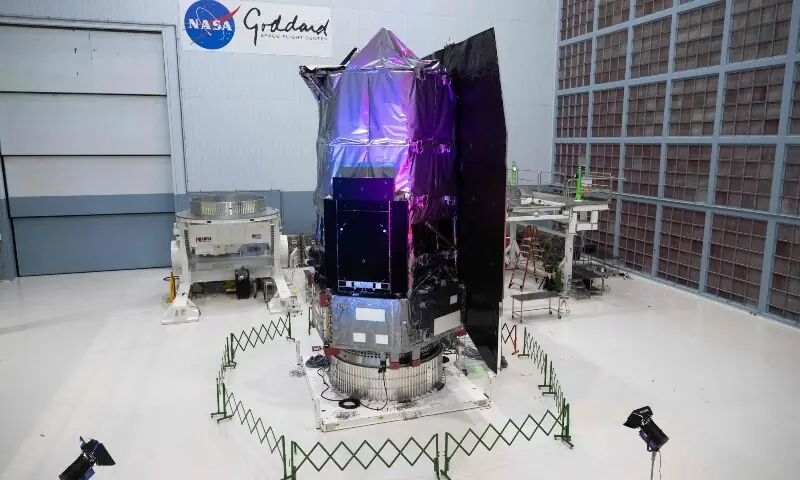
Nasa on Tuesday unveiled the Nancy Grace Roman Space Telescope, a new observatory designed to search for planets beyond the solar system and investigate the unresolved nature of dark matter and dark energy.
The telescope was presented at Nasa’s Goddard Space Flight Centre in Greenbelt, Maryland. The agency plans to send the spacecraft to Florida ahead of a SpaceX launch scheduled for September at the earliest.
Roman is expected to identify tens of thousands of planets and provide new data on how many such worlds may exist across the universe. Nasa administrator Jared Isaacman said the mission would give Earth a new atlas of the universe.
The 12-metre telescope, built over more than a decade at a cost exceeding $4 billion, is named after astronomer Nancy Grace Roman, widely known for her role in the development of the Hubble Space Telescope.
Nasa says Roman will build on Hubble’s legacy while addressing questions that remain unanswered decades after Hubble transformed space observation. With a field of view at least 100 times larger than Hubble’s, Roman will survey large sections of space from a position about 1.5 million kilometres from Earth.
The telescope is expected to transmit 11 terabytes of data to Earth each day. Mark Melton, a systems engineer at Goddard, said Roman would send more data in its first year than Hubble has produced over its entire lifetime.
Nasa officials said the observatory would reveal billions of galaxies, thousands of supernovae and tens of billions of stars, while also discovering large numbers of planets outside the solar system. The data will help scientists identify targets for follow-up study by other observatories, including the James Webb Space Telescope.
Roman will also focus on dark matter and dark energy, which scientists believe account for about 95% of the universe. Dark matter is thought to hold galaxies together, while dark energy is associated with the accelerating expansion of the universe.
Using infrared instruments, the telescope will observe ancient light from distant objects, allowing researchers to examine how dark matter evolved over cosmic time and how quickly galaxies are moving away from Earth. Scientists say the mission could significantly reshape current understanding of the universe’s structure and origins.
Comments
No comments yet. Be the first to join the discussion!