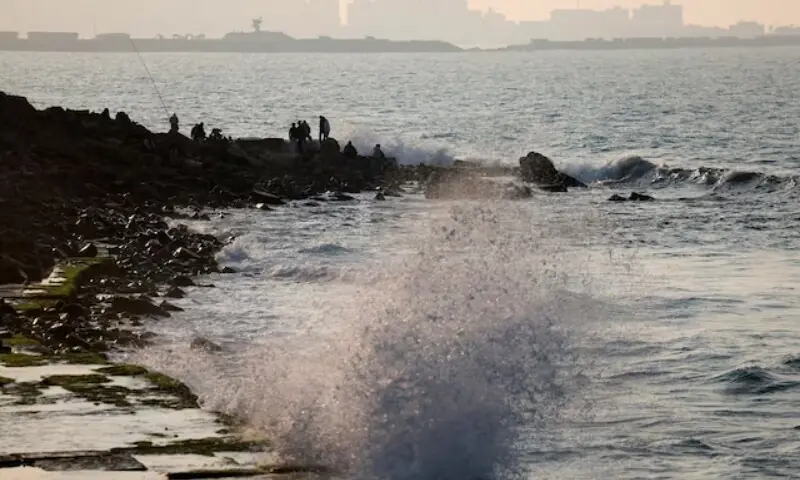
- Oceans run the rick of being destroyed– by our pollution
By Naghmana Zafar
Historically, oceans have been acknowledged as a connecting medium between continents. However, their fundamental role as cradle of life on planet earth could gain little recognition. It is not known to many, but 60 per cent of oxygen we breathe is produced by oceanic flora. Almost a similar amount of CO2 is absorbed by this blue reservoir of salt water. The oceans play a critical role in regulating weather patterns. NASA has established that 86 per cent of global evaporation is to be attributed to the seas and 78 per cent of the total precipitation in the world occurs over the oceans.
The contribution of oceans in sustaining the economic prosperity of mankind is also very decisive. Almost 90 per cent of the global trade by volume is carried out by sea. More than 50 per cent of the world population dwells along the coastal areas and the percentage will rise up to 75 per cent by 2025.A considerable amount of valuable minerals and energy resources, such as oil, gas, salt, precious metals and oceanic flora, which are used for medicines, are being extracted from oceans. The Food and Agriculture Organisation has reported that more than 3.5 million people around the world consume seafood which fulfils 20 per cent of their protein requirements. UNESCO supported the fact that oceans through fishing/seafood industry supports the livelihood of 820 million people. The number would increase if we add other direct or indirect maritime related employment activities.
While there are hundreds of thousands of known marine life forms, there are many that are yet to be discovered. It is estimated that 94 per cent of life on earth is aquatic. That makes us land-dwellers a very small minority. Hence, oceans are imperative to keep the world liveable. This calls for the recognition of the immense economic, strategic and environmental value of the oceans and make it imperative to address the issues related to sustainable usage of ocean resources.
In the last century, overexploitation and despoliation of marine ecosystems and resources has continued and intensified. Human activities and socio-economic developments have affected the oceans badly. The undesirable change in ocean chemistry, acidification, is attributed to human emission of CO2 in atmosphere. Acidification not only destroys the great reefs but also has the potential to disrupt ocean ecosystems, fisheries, habitats, and even entire oceanic food chains. It is pertinent to mention that coral reefs are known as biodiversity hot spots and fish breeding grounds.
We all have a general responsibility to protect and preserve our oceans. We must adopt an environment-friendly lifestyle and support maritime stakeholders in their efforts to promote and protect our oceans. Even just by raising awareness about the resources that oceans provide us with— from oxygen to climate, food to minerals and of course; the breathtaking beauty of this underwater wonderland— we can do our bit for the protection of this valuable asset
The factors like pollution and injudicious exploitation of oceanic resources can damage our oceans beyond repair. The fishing industry alone is responsible for 10 of marine debris. Nets and fishing gear get lost or are thrown away in the ocean. These “ghost nets” continue trapping fish for many decades. According to the estimates, every year 6.5 million tonnes of plastic, with all the toxins they contain, pose a threat to sea life and ecosystems. It has been reported that annually one million sea birds and more than 100,000 marine species are killed from plastic thrown in the seas. Large numbers of coastal and marine animals have been documented with plastic in or around their bodies. The situation in Pakistan is not different from the rest of the world. A study carried out by WWF–Pakistan revealed that 50 per cent of the plastic pollution in and around the coastal areas of Karachi is beach trash. Even traces of solid waste have been reported on secluded beaches of Baluchistan. Likewise, more than 480 million gallons of untreated sewage and industrial effluent (combined) is released into the sea from Karachi on daily basis.
In all likelihood, the diminution of marine life and environment will have far reaching effects on the national economy. Unfortunately, humans are failed to appreciate the relationship between oceans and sustainability of life on Planet Earth. We must clearly understand that there are finite limits to what the oceans can provide us and how much we can consume at the cost of our future generations. There are a number of national organisations and government departments working for change/improvement in the situation, such as IUCN and WWF, which are vigorously pursuing national campaigns on mangrove plantations under various international initiatives, demarcation of Marine Protected Areas and development of premium Marine Debris Collection Barges by Pakistan Navy are a few undertakings towards healthy oceans.
These steps will definitely have positive impact in coming years; but without addressing the sources of pollution we cannot achieve all-inclusive coastal zone management. For that reason, we all have a general responsibility to protect and preserve our oceans. We must adopt an environment-friendly lifestyle and support maritime stakeholders in their efforts to promote and protect our oceans. Even just by raising awareness about the resources that oceans provide us with— from oxygen to climate, food to minerals and of course; the breathtaking beauty of this underwater wonderland— we can do our bit for the protection of this valuable asset.
The author is maritime researcher at National Centre for Maritime Policy Research (NCMPR), Bahria University Karachi.